
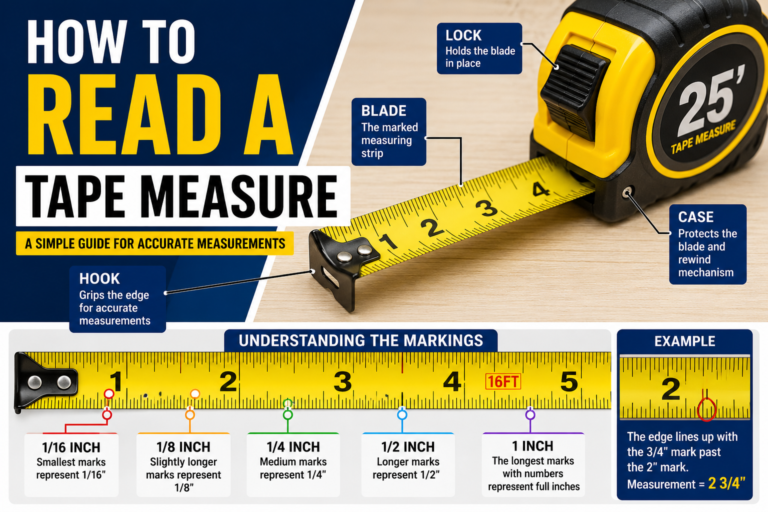
Measuring something sounds simple until you look at a tape measure and see dozens of tiny lines. Many people know how to pull out a tape measure, but they struggle to understand what all those markings mean. Learning how to read a tape measure is an essential skill for home projects, furniture shopping, construction work, sewing, and DIY tasks.
The good news is that once you understand the markings, reading a tape measure becomes quick and easy. As the saying goes, “Measure twice, cut once,” because accurate measurements save time, money, and frustration.
In this guide, you’ll learn exactly how to read a tape measure, understand every marking, and avoid common mistakes.
What Is a Tape Measure?
A tape measure is a flexible measuring tool used to determine the length, width, height, or distance of an object.
Most tape measures in the United States use inches and fractions of an inch, while many countries use the metric system (millimeters, centimeters, and meters). Some tape measures include both systems on the same blade.
Understanding the markings is the first step in mastering how to read a tape measure correctly.
Understanding the Basic Parts of a Tape Measure
Before learning the markings, it’s helpful to know the main parts.
The Hook
The metal hook at the end grabs the edge of an object. It moves slightly to compensate for its own thickness, helping provide accurate measurements.
The Blade
The blade is the long metal strip with measurement markings printed on it.
The Lock
Most tape measures have a lock button that holds the blade in place while you read the measurement.
The Case
The outer housing protects the blade and contains the spring mechanism that retracts it.
How Inches Are Marked on a Tape Measure
When learning how to read a tape measure, start with the largest markings.
The numbered marks represent full inches:
- 1 = one inch
- 2 = two inches
- 3 = three inches
- 4 = four inches
These are the easiest marks to identify because they are usually the largest numbers on the tape.
For example, if an object’s edge lines up exactly with the number 8, the measurement is 8 inches.
Understanding Fractional Inch Markings
The smaller lines between inch numbers represent fractions of an inch.
Different line lengths indicate different fractions.
1/2-Inch Marks
The second-longest lines represent 1/2 inch.
Example:
- Between 2 and 3 inches, the middle line equals 2½ inches.
If your measurement reaches that line, you have measured 2 1/2 inches.
1/4-Inch Marks
Slightly shorter lines represent 1/4 inch increments.
Examples:
- 2¼ inches
- 2¾ inches
These marks divide an inch into four equal sections.
1/8-Inch Marks
Smaller lines indicate 1/8 inch increments.
Examples include:
- 2⅛ inches
- 2⅜ inches
- 2⅝ inches
- 2⅞ inches
These provide greater precision for woodworking and construction projects.
1/16-Inch Marks
The shortest lines usually represent 1/16 inch.
Many standard tape measures divide every inch into sixteen equal parts.
For example:
- 2 1/16 inches
- 2 3/16 inches
- 2 5/16 inches
These tiny measurements may seem intimidating at first, but they become easier with practice.
Visual Breakdown of One Inch
A standard inch is divided like this:
- 1/16
- 2/16 (1/8)
- 3/16
- 4/16 (1/4)
- 5/16
- 6/16 (3/8)
- 7/16
- 8/16 (1/2)
- 9/16
- 10/16 (5/8)
- 11/16
- 12/16 (3/4)
- 13/16
- 14/16 (7/8)
- 15/16
- 16/16 (1 inch)
When learning how to read a tape measure, recognizing these common fractions makes measuring much faster.
How to Read a Tape Measure Step by Step
Follow these simple steps whenever you need a measurement.
Step 1: Place the Hook
Hook the metal end securely against the object’s edge.
Make sure it sits flat and doesn’t slip.
Step 2: Extend the Tape
Pull the tape measure across the object.
Keep it straight to avoid inaccurate readings.
Step 3: Find the Closest Inch
Locate the last full inch before the object’s edge.
For example, if the object extends past the 12-inch mark, start with 12 inches.
Step 4: Count the Fractional Mark
Look at the smaller mark where the edge lands.
Determine whether it is:
- 1/2
- 1/4
- 1/8
- 1/16
Step 5: Combine the Measurement
Add the inch number and fraction together.
Example:
- 12 inches + 3/4 inch
- Final measurement = 12¾ inches
That’s the basic process for how to read a tape measure accurately.
Real-Life Example: Measuring a Table
Imagine you’re buying a table for your dining room.
You measure the available space and find that the tape reaches:
- 60 inches
- Plus the 1/2-inch mark
The measurement is:
60½ inches
This tells you exactly how much room you have available.
As many carpenters say, “A good measurement is the foundation of a good project.”
How to Read a Tape Measure in Metric Units
Many tape measures include metric measurements.
Metric markings are usually easier because they use base-10 units.
Millimeters
The smallest lines represent millimeters (mm).
There are 10 millimeters in one centimeter.
Centimeters
Numbered marks typically indicate centimeters (cm).
For example:
- 1 = 1 centimeter
- 2 = 2 centimeters
- 3 = 3 centimeters
Meters
100 centimeters equal one meter.
If you’re measuring large objects, metric measurements can be easier because there are no fractions to calculate.
Understanding metric markings is another important part of knowing how to read a tape measure in different situations.
Common Tape Measure Symbols Explained
Some tape measures contain additional markings.
Black Diamonds
These are often used in construction layouts.
They commonly indicate spacing intervals used for framing and building materials.
Red Numbers
Many tape measures highlight every 16 inches in red.
This helps builders quickly locate standard wall stud spacing.
Foot Markings
Some tapes identify every 12 inches as one foot.
This makes larger measurements easier to read.
Common Mistakes When Reading a Tape Measure
Even experienced DIY enthusiasts make measurement errors.
Reading the Wrong Line
Small lines can look similar.
Always double-check which fraction you’re reading.
Measuring at an Angle
A tilted tape measure can produce inaccurate results.
Keep the blade straight whenever possible.
Ignoring the Hook Movement
The hook is designed to move slightly.
This movement helps maintain accuracy for inside and outside measurements.
Rushing
Many measurement mistakes happen because people hurry.
Remember the classic rule:
“Measure twice, cut once.”
Easy Tricks to Remember Fractions
Learning fractions becomes easier when you recognize patterns.
Half Inch
The longest mark between inch numbers.
Quarter Inch
Halfway between the inch mark and the half-inch mark.
Eighth Inch
Halfway between quarter-inch marks.
Sixteenth Inch
The smallest divisions.
Think of the tape measure as repeatedly splitting sections into smaller pieces.
This simple approach helps many beginners understand how to read a tape measure faster.
How Professionals Read Measurements Quickly
Professionals don’t count every line from scratch.
Instead, they memorize common fractions such as:
- 1/4
- 1/2
- 3/4
- 1/8
- 3/8
- 5/8
- 7/8
With practice, these fractions become instantly recognizable.
A carpenter may glance at a tape measure and immediately identify 15 5/8 inches without counting every mark.
The more often you practice how to read a tape measure, the faster you’ll become.
Best Practice Exercises for Beginners
Try these simple exercises at home.
Exercise 1
Measure a book.
Write down the length and width.
Exercise 2
Measure a doorway.
Record the height and width.
Exercise 3
Measure a television screen.
Compare your measurement with the manufacturer’s specifications.
Exercise 4
Measure a desk.
Check whether your measurement remains consistent each time.
These exercises build confidence and improve accuracy.
Why Learning How to Read a Tape Measure Matters
Knowing how to read a tape measure helps in countless everyday situations.
You can:
- Buy furniture confidently
- Plan home improvement projects
- Install shelves correctly
- Measure rooms accurately
- Complete DIY projects with precision
- Avoid costly mistakes
Whether you’re hanging a picture frame or building a deck, accurate measurements make every project easier.
Final Thoughts
Learning how to read a tape measure may seem challenging at first, but it becomes simple once you understand the inch markings and fractions. Start by identifying whole inches, then learn the half-inch, quarter-inch, eighth-inch, and sixteenth-inch marks.
Practice on everyday objects around your home until the markings feel familiar. Before long, you’ll be able to read measurements quickly and accurately without hesitation.
The next time you pick up a tape measure, remember that every small line has a purpose. Once you understand those markings, you’ll have a practical skill that can be useful for life.
