
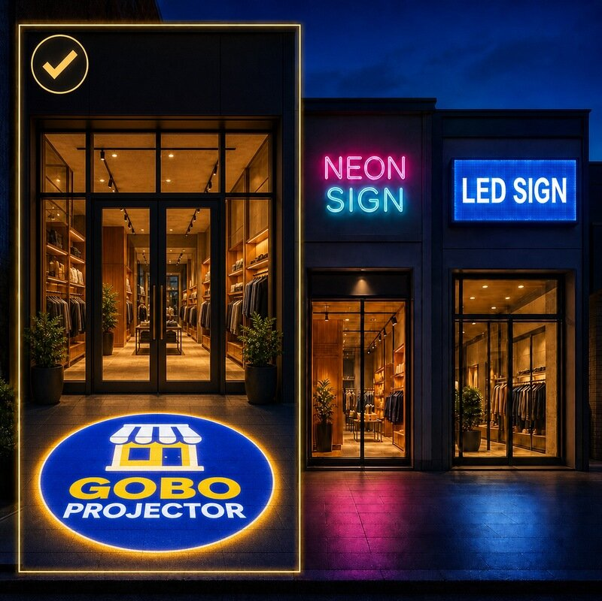
Choosing the right storefront sign can directly affect how easily customers notice, recognize, and remember your business. Neon signs create a distinctive atmosphere, while LED signs offer strong brightness and programmable content. A gobo projector provides another option: projecting a logo, message, or promotional graphic onto a wall, floor, sidewalk, or building facade.
So, which solution is best for your store?
The answer depends on your budget, location, branding needs, and how often you want to change your advertising. This guide compares gobo projectors, neon signs, and LED signs in terms of cost, flexibility, installation, visibility, maintenance, and seasonal promotions.
Quick Comparison: Gobo Projector vs Neon Sign vs LED Sign
| Feature | Gobo Projector | Neon Sign | LED Sign |
| Initial cost | Low to moderate | Moderate | Moderate to high |
| Content flexibility | High | Low | Very high |
| Installation | Simple in suitable locations | Requires wall mounting | Often requires wiring and structural support |
| Night visibility | Excellent | Excellent | Excellent |
| Daytime visibility | Depends on power and ambient light | Moderate | Good to excellent |
| Maintenance | Low | Moderate | Moderate |
| Seasonal promotions | Easy with replacement gobos | Difficult | Easy through programming |
| Best for | Logos, promotions, floors, walls, temporary campaigns | Atmosphere and decorative branding | Frequently changing text and digital advertising |
What Is a Gobo Projector?
A gobo projector is a specialized lighting device that projects an image through a custom-made slide called a “gobo.” The projected image can be a company logo, product graphic, directional symbol, promotional message, or seasonal design.
Businesses can project the image onto a storefront wall, pavement, entrance floor, window display, or nearby surface. Depending on the model, the image may remain static, rotate, or change between multiple patterns.
Unlike a physical sign, the projected image does not require a large display panel. This makes a gobo projector especially useful when a store has limited facade space or wants to avoid permanently modifying the building.
1. Cost
Cost includes more than the initial purchase price. Store owners should also consider customization, installation, electricity use, content updates, repairs, and replacement components.
Gobo projector cost
A gobo projector generally offers a cost-effective balance between professional branding and visual impact. The main expenses include the projector, mounting accessories, and a custom gobo.
Changing the displayed design usually requires replacing the gobo rather than purchasing an entirely new projector. One device can therefore support the permanent store logo as well as future sales, events, and holiday campaigns.
Projectors are available in different power levels, so a business can select a model based on projection distance, image size, and ambient light instead of paying for unnecessary output.
Neon sign cost
A custom neon sign requires a frame, shaped tubing or flexible LED-neon material, electrical components, and professional fabrication. Complex lettering, multiple colors, and large dimensions can increase the price.
If the store later changes its logo or slogan, the sign may need to be rebuilt. Neon is therefore better suited to long-term branding than regularly changing promotions.
LED sign cost
Simple LED light boxes can be affordable, but programmable LED displays may require a substantial investment. Costs increase with screen size, pixel density, weather resistance, control systems, and installation requirements.
For stores that update messages every day, the higher initial cost may be justified. For a business displaying one logo or a small number of promotions, a full LED display may offer more functionality than necessary.
Cost winner: The gobo projector is often the most economical option for customizable visual branding.
2. Flexibility
Flexibility is one of the most important differences between these three solutions.
A gobo projector can display logos, text, icons, patterns, and promotional artwork. The same projector can be repositioned to cast an image onto different surfaces. A shop might project its logo on the facade during normal operations and use a “Holiday Sale” gobo on the sidewalk in December.
Neon signs are much less flexible. Their fixed shape is part of their appeal, but the content cannot be changed without modifying or replacing the sign.
Programmable LED signs offer the greatest content flexibility. Stores can display changing prices, announcements, animations, and multiple messages. However, this flexibility comes with higher equipment costs and a more digital, screen-like appearance that may not suit every brand.
Flexibility winner: LED signs for frequently changing digital content; gobo projectors for affordable, interchangeable visual campaigns.
3. Installation
Installing a gobo projector usually involves securing a mounting bracket, connecting power, inserting the gobo, and adjusting the focus and projection angle. The projector must have a clear path to the target surface.
Correct positioning matters. Projection distance affects image size, while an extreme angle may distort the design. Outdoor installations should use a weather-resistant projector with an appropriate IP rating.
Neon signs are mounted directly to a wall, window, or supporting frame. Installation may require drilling, cable management, and professional electrical work. Large signs also need adequate structural support.
LED signs can be the most complicated to install. A large outdoor display may require a reinforced frame, dedicated electrical wiring, weather protection, data connections, and local signage approval.
Installation winner: A gobo projector is generally the easiest option when a suitable mounting position and projection surface are available.
4. Visibility During the Day and at Night
All three sign types can perform well after dark, but their daytime performance varies.
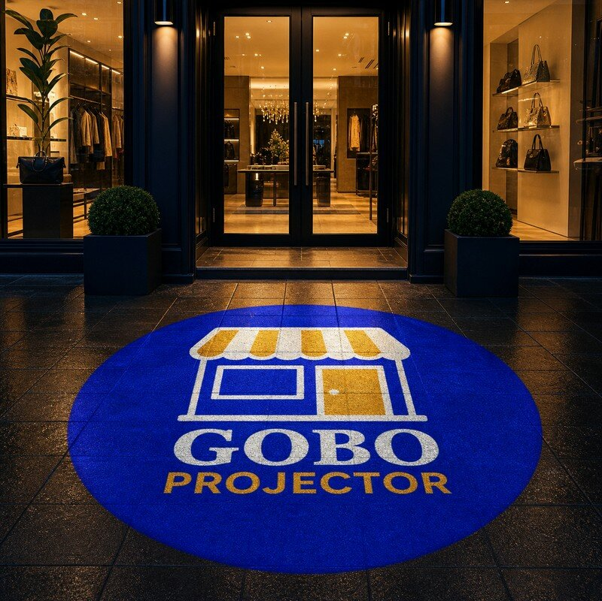
Gobo projections are highly noticeable at night, particularly on light-colored, matte surfaces. Movement or rotation can make the image even more eye-catching. During daylight, however, visibility depends on projector power, projection distance, surface color, and ambient brightness. Direct sunlight can overwhelm many projected images.
For bright indoor stores or long projection distances, choosing adequate power is essential. Noparde offers commercial models for different installation heights and lighting environments, including weather-resistant options for outdoor storefronts.
Neon signs create a warm, recognizable glow at night. They are especially effective for restaurants, bars, salons, cafés, and lifestyle stores. In strong daylight, neon may appear less prominent unless it is combined with a contrasting backing panel.
A high-brightness LED sign generally provides the strongest daytime visibility. It can remain readable in busy, well-lit commercial areas, although brightness should be adjusted after dark to avoid glare.
Visibility winner: LED signs for all-day visibility; neon and gobo projectors for distinctive nighttime impact.
5. Maintenance and Durability
Modern LED-powered gobo projectors typically require limited routine maintenance. Store owners may need to clean the lens, check the mount, and keep the projection surface clear. Outdoor equipment should have suitable protection against rain and dust.
The gobo itself experiences no outdoor fading because it remains protected inside the projector. When a campaign ends, it can be removed and stored for future use.
Traditional glass neon tubing can be fragile and may require specialist repair if damaged. LED-neon alternatives are more durable, but power supplies and individual light sections can still fail over time.
LED signs contain many electronic components. A quality display can operate for years, but damaged modules, controllers, or power supplies may require technical service. Large screens also need periodic cleaning and inspection.
Maintenance winner: A commercial gobo projector usually provides the simplest maintenance for a logo-based storefront display.
6. Seasonal Promotions
Seasonal marketing is where a gobo projector becomes particularly valuable.
A retailer can maintain a set of interchangeable gobos for Christmas, Halloween, Valentine’s Day, Black Friday, new-product launches, and clearance sales. Instead of covering the storefront with temporary banners, the business can change the projected design while continuing to use the same hardware.
Projection also makes underused space valuable. A blank pavement area can become a promotional display, while an exterior wall can feature a seasonal graphic without paint, adhesive, or a permanent fixture.
A neon sign is less practical for short campaigns because every design must be fabricated as a separate physical sign.
An LED display is also excellent for seasonal promotions. Content can be changed immediately through its control system. However, a full LED screen may be unnecessarily expensive when a business only needs several branded designs throughout the year.
Seasonal promotion winner: Gobo projectors for cost-effective visual campaigns; LED signs for daily or real-time updates.
Which Storefront Sign Should You Choose?
Choose a gobo projector if you want:
· A custom logo without a large physical sign
· Strong nighttime visibility
· Interchangeable seasonal promotions
· Projection onto walls, floors, or sidewalks
· Low-maintenance commercial branding
· A flexible solution for rented or temporary retail spaces
Choose a neon sign if you want:
· A fixed decorative feature
· A warm, nostalgic, or artistic atmosphere
· A design that will remain unchanged for years
· An attractive background for customer photos
Choose an LED sign if you want:
· Strong daytime and nighttime visibility
· Frequently changing text, prices, or announcements
· Animations or multiple messages
· Centralized digital content control
Final Verdict
There is no universal winner for every storefront. LED signs provide the greatest content control and daytime brightness, while neon signs offer a distinctive decorative style. For many boutiques, cafés, restaurants, shopping centers, and service businesses, however, a gobo projector delivers the best combination of cost, flexibility, simple installation, and promotional versatility.
It allows a store to turn an ordinary wall or pavement into branded advertising without installing a bulky screen or permanently changing the building. With the correct power, lens, mounting position, and outdoor protection, one projector can support both everyday branding and seasonal campaigns.
Explore Noparde custom logo projectors to find a projection solution suited to your storefront, installation distance, and visibility requirements.
