
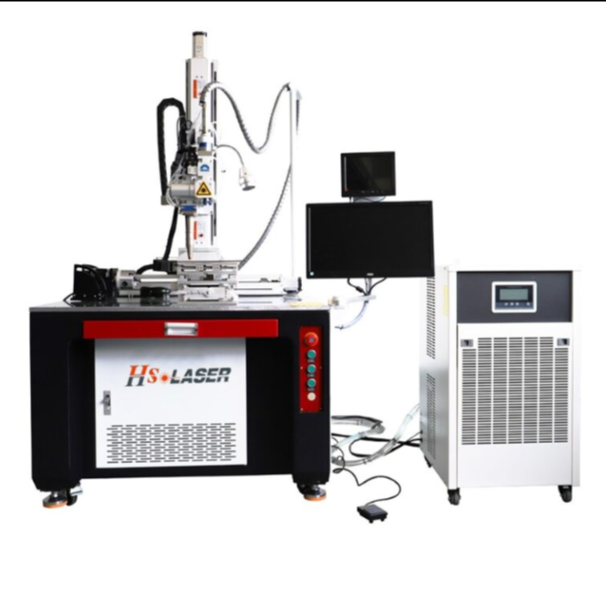
Contemporary manufacturing processes require robust welded joints. At the same time, productivity, repeatability, accuracy, and streamlined operations also play critical roles. These requirements highlight why choosing an automated fiber laser welding machine is essential for today’s manufacturing businesses.
The main distinction between conventional welding techniques and laser welding is the reliance on automation. Fiber laser welding involves combining precise fiber laser irradiation with coordinated movement systems. In addition to automation benefits, laser welding offers superior welding speeds, smaller weld sizes, and minimal thermal distortions.
What Is an Automatic Fiber Laser Welding Machine?
An Automatic fiber laser welding machine combines the use of a laser light source to join metals in an automated way. The concentrated beam delivers thermal energy into a focused region of metal. Heat melts the metal and creates a weld seam once it solidifies.
Automated describes a manufacturing process where welding parameters and motion are controlled without manual input. Depending on the equipment, automation can take various forms like CNC positioning, robotics, fixture assemblies, and sensor systems.
Applications range from automotive parts to medical components, consumer goods, aerospace products, and others requiring material combinations including stainless steels, carbon steels, aluminum alloys, titanium, and nickel alloys. Proper power output settings vary based on component material composition and thicknesses.
How Does Automatic Fiber Laser Welding Work?
The first stage involves the precise arrangement of workpieces relative to each other.
The laser source focuses the laser beam onto the workpiece joints. High-power density melts the local area around the beam focal point.
The molten pool solidifies during laser traversal according to preset instructions. The result is fusion of materials between two pieces.
Automation assists the process by controlling movement and repeat accuracy. In production settings, automation can eliminate variability due to manual handling and operator tiredness.
Joint preparation remains crucial. Compared with traditional welding methods, laser welding allows less deviation from the optimal gap width and alignment. Positioning systems and seam tracking technology might compensate for minor misalignments.
Key Benefits of Automatic Fiber Laser Welding
Faster Production
Laser welding can operate at high speeds, particularly when joining suitable thin and medium-section materials. Its ability to complete some joints in a single pass can also improve productivity.
This makes fiber laser welding useful for production lines where cycle time matters.
Consistent Weld Quality
Automation allows the machine to follow programmed welding paths repeatedly. This can improve consistency across large batches.
For manufacturers producing the same components many times, repeatability can be a major advantage. Automated welding systems can also reduce variations associated with manual operation.
Lower Heat Input and Distortion
Focused heat delivery is one of the critical characteristics of laser welding. The laser welding process can apply heat to a small area of the spot.
This leads to a reduction in thermal distortion and heat affected zones compared with conventional welding techniques. These characteristics are great advantages when components need to be visually attractive or accurately measured.
Reduced Manual Intervention
In repetitive processes, the manual guidance of the welding torch is eliminated due to welding automation.
Rather, the operator can focus on such things as setting up equipment, inspecting welds, handling materials and monitoring the process.
Where Are Automatic Fiber Laser Welding Machines Used?
The technology has applications across several manufacturing sectors.
Automotive manufacturing uses laser welding for various vehicle components and assemblies where speed and repeatability are important.
Metal fabrication can benefit from automated welding when producing repeated parts, enclosures, frames, and other fabricated components.
Hardware manufacturing can use laser welding for precise joints and clean finished products.
Jewelry manufacturing may use laser technology for detailed welding and repair applications where controlled heat input is important.
Mold and tool production can also benefit from precise laser welding for repair and refurbishment work.
The broader laser welding industry includes applications in automotive, aerospace, medical devices, shipbuilding, and other advanced manufacturing sectors.
How to Choose the Right Laser Power
Laser power should not be selected based only on the machine’s maximum rating. The correct specification depends on the actual welding application.
Consider:
- Material type
- Material thickness
- Joint configuration
- Required penetration
- Welding speed
- Production volume
- Part dimensions
- Required surface finish
- Level of automation
For example, a manufacturer working primarily with thin stainless steel components may have different requirements from a company welding thicker carbon steel parts.
A suitable machine should match the production process rather than simply offering the highest available power.
What Should You Consider Before Buying?
The laser source is only one part of an automated welding system.
Look at the complete machine configuration. Consider the working area, motion system, laser head, control system, cooling arrangement, fixturing, safety features, and available automation options.
It is also important to evaluate technical support and after-sales service. Training, installation assistance, spare parts, and troubleshooting can affect the long-term value of industrial equipment.
Production volume matters as well. Automation usually requires a higher initial investment than manual equipment. It becomes more attractive when consistent output, repeat production, and reduced process variation can justify that investment.
Why Automation Matters in Modern Welding
Welding automation has little use unless the system improves process control for repeated manufacturing operations. An effective system allows predictability in output and ensures consistency in welds. Automation can also eliminate monotonous tasks from daily operations.
Before implementing any automation process, it is crucial to review existing production processes. Factors like part placement, programming, maintenance, training, and capital investment must be considered during implementation.
Conclusion
Automatic fiber laser welding machines utilize precise laser energy combined with automated motion and control techniques. Potential benefits include higher productivity, repeatable weld quality, minimal thermal distortion, and reduced operator involvement.
Automated systems offer manufacturers producing regular batches of metal parts an alternative towards increased fabrication control and efficiency. It is essential to remember that the appropriate machine needs to be chosen depending on material, thickness, joint configuration, batch size, and desired degree of automation.
FAQs
1. What is an automatic fiber laser welding machine?
An automatic fiber laser welding machine is a device used in industrial applications that combines an automated control function with a fiber laser source for welding metal parts. The system provides benefits of accuracy, consistency and productivity.
2. What metals can a fiber laser welding machine weld?
Different kinds of metal can be joined by a fiber laser welding process. The metals include stainless steel, carbon steel, aluminum, titanium and nickel-based alloys. The welding parameters to be used have to be determined for each material characteristic and thickness.
3. Is automatic laser welding better than manual welding?
The choice of the laser welding technology should be application oriented. Automated laser welding is a good choice for repetitive production jobs, since it produces consistent, repeatable welds.
However, manual welding is still adequate for small production runs and projects that need customized solutions.
4. How do I choose the right automatic fiber laser welding machine?
The first step when choosing a laser welding machine is to decide on the material type, thickness, joint design, production volume, required weld speed and the level of automation.
It is important to evaluate parameters such as laser power output, workspace, control system, system configuration and safety systems.
