
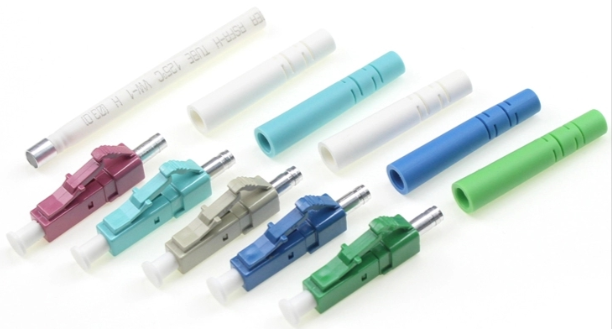
Modern data centers need compact and organized fiber connections. As network speeds and fiber counts increase, connecting high-density trunks to individual optical ports can become more challenging.
MTP fanout cables can be used to solve the above challenge, whereby an MTP interface is connected to multiple fiber connectors. The above design makes the connection between trunk cables, patch cords, and network devices simple.
What Is an MTP Fanout Cable?
An MTP fanout cable is a fiber optic assembly that branches one multi-fiber MTP connection into multiple individual fiber connections.
The MTP side provides a high-density interface. The opposite side can use individual LC connectors or other connector configurations, depending on the cable design.
This arrangement allows a high-density fiber trunk to connect with equipment that uses individual fiber ports. OMC describes its MTP-LC fanout cables as solutions for connecting MTP trunks with general LC ports in data centers and enterprise networks.
How Does an MTP Fanout Cable Work?
The cable begins with a multi-fiber MTP connector. Inside the assembly, multiple optical fibers are routed to individual connectors at the opposite end.
For an MTP-LC configuration, the fibers branch out into LC connections. These individual LC connectors can then connect with compatible transceivers, patch panels, cassettes, or other fiber equipment.
This provides a practical transition between high-density trunk infrastructure and individual optical interfaces.
Why Use an MTP Fanout Cable?
High-Density Connectivity
MTP technology allows multiple fibers to be handled through a compact connector.
This can help reduce the amount of space needed for fiber connections. It is especially useful in environments where rack space and cable organization are important.
Easier Network Integration
Many network devices use individual LC interfaces.
An MTP fanout cable provides a convenient way to connect these ports with an MTP-based trunk system. This can make it easier to integrate different parts of a high-density fiber architecture.
Better Cable Organization
Large data centers can contain a significant number of fiber connections.
A structured fanout assembly can help organize these connections and reduce unnecessary cable routing. Better organization can also make future maintenance easier.
Efficient Deployment
Factory-terminated fanout cables can reduce the amount of termination work required during installation.
OMC states that its MTP-LC fanout assemblies are factory pre-terminated and tested. This can help provide repeatable connections and simplify deployment.
MTP Fanout Cable Applications
Data Centers
Data centers are a major application for MTP fanout cables.
They can connect high-density MTP trunk infrastructure to individual LC-based network equipment. OMC positions its MTP-LC fanout cables for high-speed and high-density data center applications.
Enterprise Networks
Large enterprise networks may also use MTP-based fiber infrastructure.
Fanout cables can help connect centralized fiber systems with individual network interfaces while keeping the cabling structured.
High-Speed Network Connections
MTP-LC assemblies can support network architectures involving different high-speed optical connections.
OMC lists applications including 10G, 40G, and 100G environments for relevant MTP-LC cable assemblies. The actual suitability depends on the complete optical system and connected equipment.
MTP Fanout Cable Configurations
MTP fanout cables are available in different configurations.
Important variables can include:
- Fiber count
- MTP connector type
- LC connector configuration
- Single-mode or multimode fiber
- Cable length
- Fanout length
- Connector polarity
- Cable construction
OMC lists 8F, 12F, and 24F MTP-LC harness cable configurations, along with MTP-to-LC fanout options.
The appropriate configuration should be selected according to the network architecture.
MTP vs. MPO
MTP and MPO are closely related multi-fiber connector technologies.
MTP is a connector brand developed by US Conec, while MPO refers to the broader multi-fiber push-on connector interface. MTP connectors are designed to provide performance and mechanical features suitable for high-density applications.
OMC states that its US Conec MTP connectors are compatible with MPO connectors.
Compatibility should still be verified based on connector specifications, polarity, gender, and the complete network design.
Single-Mode vs. Multimode
Fiber type is another important consideration.
Single-mode fiber is used widely in optical transmission where there is a need to cover greater distances.
Multimode fiber is often used in cases where there is a need to transmit over shorter distances.
It is important to choose depending on the distance to be covered.
In its MTP-LC solution, OMC offers both single-mode and multimode solutions.
How to Choose the Right MTP Fanout Cable
Check the Fiber Count
First, determine how many optical fibers the network requires.
The cable should match the number of connections needed at both ends. Choosing an appropriate fiber count can also help accommodate future expansion.
Verify Connector Compatibility
Check the MTP connector and individual connector types.
For MTP-LC applications, confirm that the LC connectors match the equipment, patch panel, or cassette being used.
Consider Fiber Type
Choose single-mode or multimode based on the optical network.
The fiber type should match the transceivers and other connected components.
Check Polarity
Polarity is critical in multi-fiber systems.
Transmit and receive fibers must align correctly across the complete link. Incorrect polarity can prevent the optical connection from working properly.
Consider Cable Length
Select a length that matches the actual routing path.
Too little cable can make installation difficult. Excessive cable can create unnecessary slack and complicate cable management.
Installation and Handling Considerations
Fiber optic assemblies require careful handling.
Avoid excessive pulling, crushing, twisting, or tight bends during installation. The cable should be routed according to its specified bend-radius requirements.
Connector cleanliness is also important. Dust or contamination on fiber end faces can increase optical loss and affect network performance.
Before connecting an MTP fanout cable, inspect the connector interfaces and verify that the configuration matches the planned network.
After installation, appropriate optical testing can help confirm link performance.
Optical Performance Matters
A fanout cable should not be selected only because its connectors physically fit.
Optical characteristics also matter.
Insertion loss measures the optical power lost through a connection. Return loss relates to reflected optical power. Both can influence the performance of an optical link.
OMC publishes performance specifications for its MTP-LC fanout assemblies, including insertion-loss and return-loss values for different fiber and connector configurations.
The required performance should always be evaluated against the optical budget of the complete network.
Why Choose a Reliable MTP Fanout Cable Manufacturer?
A reliable manufacturer can help ensure consistent connector termination and suitable cable configurations.
OMC offers MTP-LC fanout and harness cables in several configurations. Its published range includes 8F, 12F, and 24F options, with straight and staggered harness designs as well as dedicated fanout assemblies.
OMC also states that its MTP-LC products use US Conec MTP connectors and Corning optical fiber in the relevant product series. Its LC connectors are manufactured and tested according to listed industry standards.
When selecting a cable for a specific project, provide the required fiber count, connector configuration, fiber type, length, polarity, and equipment interface. These details help ensure better compatibility.
Frequently Asked Questions
What is an MTP fanout cable?
The MTP fanout cable is the fiber optic cable assembly that interfaces an MTP connector that carries multiple fibers to multiple single-fiber connectors.
What is the MTP-LC fanout cable used for?
The MTP-LC fan-out cables are commonly used for interfacing the MTP trunk cabling system with equipment requiring single LC interface connections. MTP-LC cables are frequently used in data centers and enterprise networks.
What is the difference between MTP and MPO connectors?
The MPO connector is a generic multi-fiber connector interface, and the MTP connector is one brand of such connectors produced by the company US Conec based on the MPO interface.
Are MTP fanout cables available for single-mode and multimode fiber?
Yes. MTP-LC fanout assemblies can be produced for both single-mode and multimode applications. The correct fiber type depends on the network architecture, transmission distance, and connected optical equipment.
How do I choose an MTP fanout cable?
Consider fiber count, MTP and LC connector types, fiber type, polarity, cable length, optical performance, and equipment compatibility. These factors should be matched with the requirements of the complete fiber network.
Conclusion
Use of an MTP fanout cable is one efficient solution that allows connecting the multi-fiber infrastructure to single-fiber optical ports. Using an MTP connection together with several fanout connections may make cabling easier.
While choosing an MTP fanout cable, the parameters such as fiber count, connector type, fiber type, polarity, cable length, and optical characteristics have to be taken into account.
