
The US iGaming market presents opportunities for operators, investors, and technology providers, but entering the market requires a clear understanding of its regulatory structure. Unlike jurisdictions with a single national gambling regulator, online gaming in the United States is primarily governed through individual states.
For businesses considering an online casino launch, regulation needs to be considered alongside technology, payments, player verification, responsible gaming, and day-to-day operations. A turnkey platform can simplify some technical requirements, but it does not remove the operator’s responsibility to comply with applicable laws.
Understanding the US iGaming Regulatory Structure
The first issue for any prospective operator is determining where online casino gaming is legally authorized. State requirements can differ considerably, including rules covering licensing, partnerships, approved suppliers, game testing, player location verification, and responsible gaming.
This creates a practical challenge for businesses planning expansion. A platform configured for one jurisdiction may require additional technical or compliance work before it can be used in another.
For operators, the initial regulatory assessment should answer several questions:
- Is online casino gaming authorized in the target state?
- Which regulator oversees the activity?
- What type of operator or supplier authorization is required?
- Is a partnership with an existing gaming entity necessary?
- What technical standards apply to the platform and games?
- What player-protection controls are required?
- What tax, reporting, and fee obligations apply?
These questions should be addressed before committing to a technology provider or launch schedule.
Why Licensing Costs Need Careful Research
Searching for an online gambling license cost can produce misleadingly simple answers. There is no single US-wide price because licensing requirements depend on the jurisdiction, the type of authorization, and the applicant’s role in the gaming ecosystem.
A business may need to account for application fees, licensing fees, renewals, regulatory assessments, technical certification, compliance personnel, legal work, audits, and other operational expenses. Some costs are paid directly to regulators, while others arise from meeting regulatory requirements.
For investors, this means a realistic market-entry budget should include more than the headline license fee. Technology certification, compliance infrastructure, payment arrangements, legal advice, and ongoing reporting can all affect the total cost of operating a regulated platform.
What Is a Turnkey Online Casino Solution?
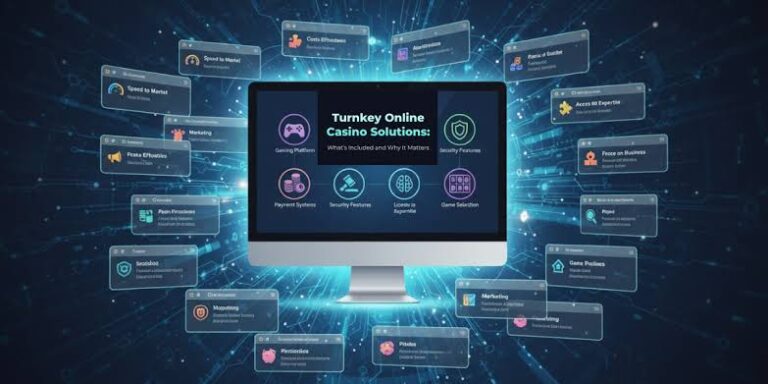
A turnkey online casino solution is a technology package designed to provide many of the core components needed to operate an online casino through a single platform arrangement.
Depending on the provider and jurisdiction, a turnkey solution may include:
- Casino management and player-account systems
- Game aggregation and content management
- Payment integrations
- KYC and player-verification tools
- Geolocation functionality
- Responsible-gaming features
- Back-office reporting
- Bonus and promotional management
- Security and fraud-monitoring tools
- Customer-support functionality
- Analytics and operational dashboards
The exact package varies between suppliers. Operators should therefore examine the actual technical and compliance scope rather than assuming every turnkey platform provides the same services.
Key Advantages for Business Operators
Faster Technology Deployment
Building an online casino platform internally can involve multiple technology layers, integrations, testing processes, and maintenance responsibilities.
A turnkey model can provide an established technical foundation, allowing a business to concentrate more resources on market strategy, regulatory preparation, customer acquisition, and operations.
However, faster technical deployment should not be confused with faster regulatory approval. Licensing remains a separate process controlled by the relevant authority.
Lower Internal Development Requirements
An operator purchasing a turnkey solution may not need to build every component from the ground up. This can reduce the need for a large internal software-development operation and simplify ongoing platform maintenance.
For smaller businesses and new market entrants, this can be particularly relevant because technology development can require significant capital before the business begins generating revenue.
Integrated Compliance Features
Modern regulated-market platforms can incorporate tools for identity verification, geolocation, transaction monitoring, responsible gaming, and regulatory reporting.
This does not make a platform automatically compliant. The operator still needs to confirm that the technology meets the specific requirements of the jurisdiction in which it intends to operate.
Easier Content and Payment Management
Casino operators typically need access to multiple game suppliers and payment methods. A platform with established integrations can reduce the number of separate technical relationships that the business needs to manage.
The practical benefit is not simply having more games or payment options. It is having those components organized within a system that provides centralized administration and reporting.
What Buyers Should Check Before Choosing a Platform
Businesses considering a turnkey solution should evaluate the provider from both a commercial and regulatory perspective.
Important areas include:
- Jurisdictional compatibility: Confirm that the platform can meet the technical requirements of the target US market.
- Compliance functionality: Review KYC, AML, geolocation, responsible-gaming, and reporting capabilities.
- Game certification: Establish how games are tested and whether relevant testing requirements can be satisfied.
- Payment infrastructure: Check which payment providers and transaction methods are supported.
- Scalability: Determine whether the platform can support additional jurisdictions if the business expands.
- Data and security: Understand how player and transaction information is protected and managed.
- Commercial terms: Examine setup charges, recurring fees, revenue arrangements, integration costs, and support provisions.
- Regulatory responsibility: Clearly establish which compliance obligations remain with the operator.
A provider’s sales presentation should not replace independent legal and regulatory review.
Planning a Sustainable US Market Entry
For operators and investors, technology and regulation need to be planned together. A platform may offer extensive functionality, but its commercial value depends on whether it can operate within the regulatory framework of the intended market.
Businesses looking to buy online casino turnkey technology should begin by defining their target jurisdiction, business model, licensing pathway, and operational requirements. The platform can then be evaluated against those requirements rather than selected solely on features or price.
The US iGaming environment differs from state to state. For decision-makers, a practical approach is to treat each market as a separate regulatory project while choosing technology that can support future expansion. This helps align technology investment with licensing, compliance, and long-term business planning rather than treating the platform as a standalone purchase.
