
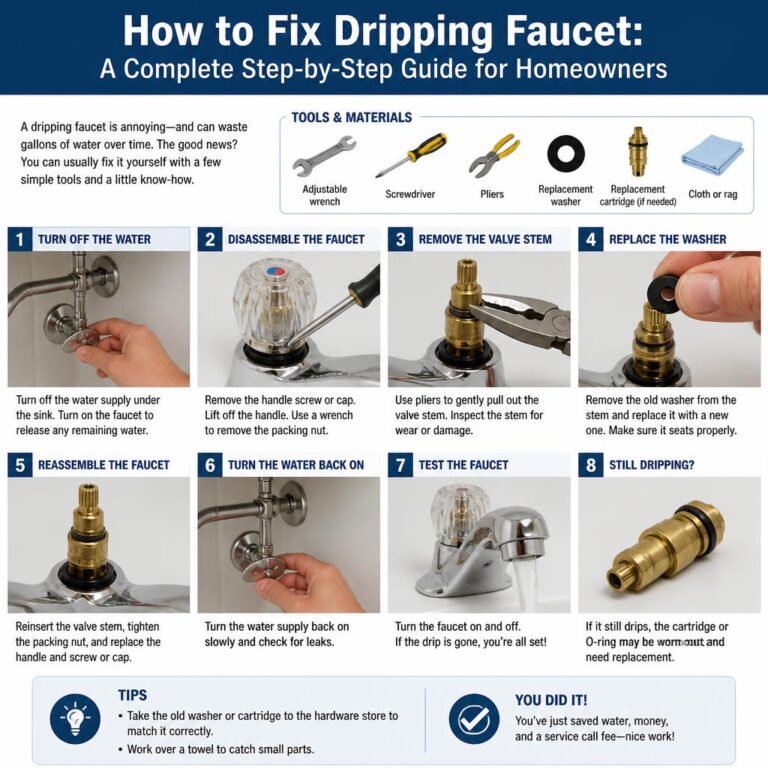
A dripping faucet may seem like a small problem, but those constant drops can waste a surprising amount of water over time. More importantly, the sound of a leak can become frustrating, especially at night. The good news is that learning how to fix dripping faucet issues is often easier than most people think.
Whether you’re dealing with a kitchen tap or searching for answers about how to fix dripping faucet bathroom problems, this guide will walk you through everything you need to know in a simple and practical way.
Why Is Your Faucet Dripping?
Most faucet leaks happen because a small part inside the faucet has worn out. Over time, components such as washers, O-rings, seals, or cartridges can become damaged.
Think of a faucet like a door lock. If one tiny piece stops working properly, the entire mechanism can fail. In the same way, a worn washer can cause water to keep dripping even when the handle is fully closed.
Common causes include:
- Worn-out washers
- Damaged O-rings
- Faulty faucet cartridges
- Corroded valve seats
- Loose faucet parts
- High water pressure
Understanding the cause is the first step in learning how to fix dripping faucet problems correctly.
Tools You May Need
Before starting, gather a few basic tools.
Essential Tools
- Adjustable wrench
- Screwdriver set
- Allen wrench
- Plumber’s tape
- Replacement washers
- Replacement O-rings
- New faucet cartridge (if needed)
- Clean cloth
Having everything ready beforehand makes the repair process much smoother.
Turn Off the Water Supply First
Before taking apart any faucet, always shut off the water supply.
Look under the sink for the hot and cold water shut-off valves. Turn both valves clockwise until they stop.
After shutting off the water:
- Open the faucet
- Let remaining water drain out
- Plug the sink drain to prevent losing small parts
This simple step can save you from an unexpected mess.
Identify Your Faucet Type
Different faucet types require different repair methods.
Compression Faucets
These use rubber washers and typically have separate hot and cold handles.
Cartridge Faucets
These contain a cartridge that controls water flow.
Ball Faucets
Often found in kitchens and use a rotating ball mechanism.
Ceramic Disk Faucets
These use ceramic disks and are known for durability.
Knowing the faucet type helps determine the correct repair approach when figuring out how to fix dripping faucet issues.
How to Fix Dripping Faucet in a Compression Faucet
Compression faucets are one of the most common sources of leaks.
Step 1: Remove the Handle
Use a screwdriver to remove the decorative cap and handle screw.
Carefully lift off the handle.
Step 2: Remove the Stem
Use a wrench to loosen and remove the faucet stem.
You should now see the rubber washer attached to the bottom.
Step 3: Replace the Washer
Inspect the washer carefully.
If it appears cracked, flattened, or worn, replace it with an identical size.
A fresh washer often solves the entire dripping problem.
Step 4: Reassemble the Faucet
Put all parts back together in reverse order.
Turn the water supply back on and test the faucet.
In many cases, this simple repair completely fixes the leak.
How to Fix Dripping Faucet Bathroom Models
Bathroom faucets experience daily use, which causes internal components to wear down.
If you’re researching how to fix dripping faucet bathroom fixtures, the process usually involves replacing either the cartridge or O-ring.
Remove the Faucet Handle
Locate the set screw and remove the handle.
Depending on the model, you may need an Allen wrench.
Inspect the Cartridge
Pull out the cartridge carefully.
Look for:
- Cracks
- Mineral buildup
- Visible wear
A damaged cartridge is one of the most common causes of bathroom faucet leaks.
Install a New Cartridge
Take the old cartridge to a hardware store and purchase an exact replacement.
Install the new cartridge and reassemble the faucet.
This repair often stops bathroom faucet leaks immediately.
How to Fix Dripping Faucet in Bathroom Sink
Many homeowners specifically search for how to fix dripping faucet in bathroom sink because sink faucets tend to develop leaks after years of use.
The repair process depends on the faucet design, but the following steps work for most models.
Check the O-Ring
The O-ring creates a watertight seal around moving parts.
If the ring becomes worn or brittle, water may leak continuously.
Remove the old O-ring and install a new one of the same size.
Clean Mineral Deposits
Hard water can leave behind mineral buildup inside the faucet.
Use vinegar to dissolve deposits.
A clean faucet often functions much better and may eliminate minor dripping.
Replace Internal Seals
If the leak continues, inspect internal seals.
Even a tiny damaged seal can allow water to escape.
Replacing inexpensive seals can save the cost of replacing the entire faucet.
How to Fix a Cartridge Faucet That Won’t Stop Dripping
Cartridge faucets are popular because they are easy to operate.
However, when the cartridge wears out, leaks can occur.
Remove the Retaining Clip
Most cartridge faucets contain a retaining clip holding the cartridge in place.
Carefully remove it.
Pull Out the Cartridge
Use pliers if necessary.
Avoid excessive force to prevent damaging the faucet body.
Install a Replacement
Insert the new cartridge exactly as the old one was positioned.
Reassemble everything and test the faucet.
Many plumbers will tell you, “A worn cartridge is often the hidden culprit behind a faucet that simply refuses to stop dripping.”
Check the Valve Seat
The valve seat connects the faucet to the spout.
Over time, mineral deposits and corrosion can damage this component.
Signs of a damaged valve seat include:
- Persistent dripping
- Uneven water flow
- Increased faucet noise
Clean the valve seat thoroughly.
If it is severely corroded, replacement may be necessary.
Can High Water Pressure Cause Dripping?
Yes.
Sometimes homeowners replace parts repeatedly without realizing the real issue is water pressure.
Excessively high pressure can force water through closed valves.
Signs include:
- Dripping only at certain times
- Leaks during nighttime
- Faucet noise when turning off water
If you suspect pressure problems, consider checking your home’s pressure regulator.
Prevent Future Faucet Leaks
After learning how to fix dripping faucet problems, it’s smart to take preventive measures.
Avoid Over-Tightening Handles
Many people close faucets with excessive force.
This can wear out washers and seals faster.
Clean Faucets Regularly
Mineral buildup accelerates wear on internal components.
Regular cleaning helps parts last longer.
Replace Small Parts Early
Washers and O-rings cost very little.
Replacing them before they completely fail can prevent larger issues.
Monitor Water Pressure
Keeping water pressure at a reasonable level protects your plumbing system.
Small maintenance habits can significantly extend faucet life.
When Should You Replace the Entire Faucet?
Sometimes repairs are no longer worth the effort.
Consider replacement if:
- The faucet is very old
- Corrosion is extensive
- Replacement parts are unavailable
- Multiple repairs have failed
Modern faucets are often more efficient and can help reduce water waste.
As many experienced homeowners say, “The cheapest repair is not always the most economical solution.”
Common Mistakes to Avoid
When learning how to fix dripping faucet, avoid these common errors.
Using the Wrong Replacement Parts
Even slight size differences can prevent a proper seal.
Forgetting to Shut Off Water
This mistake can create an unexpected flood under the sink.
Overtightening Components
Too much force can crack parts or damage threads.
Losing Small Pieces
Always plug the drain before starting work.
Small screws and clips are easy to lose.
Frequently Asked Questions
How long does it take to fix a dripping faucet?
Most repairs take between 20 and 60 minutes depending on the faucet type.
Can a dripping faucet increase my water bill?
Yes. Even a slow drip can waste hundreds or thousands of gallons annually.
Do I need a plumber?
Not always. Many homeowners successfully complete the repair themselves using basic tools.
What is the most common cause of faucet dripping?
A worn washer, O-ring, or cartridge is usually responsible.
Is fixing a faucet cheaper than replacing it?
In most cases, yes. Replacement parts are inexpensive and often solve the issue immediately.
Final Thoughts
Learning how to fix dripping faucet problems can save money, reduce water waste, and eliminate one of the most annoying household sounds. Whether you’re dealing with a kitchen fixture, researching how to fix dripping faucet bathroom leaks, or specifically trying to understand how to fix dripping faucet in bathroom sink setups, most repairs involve replacing a small worn component.
Start by identifying the faucet type, shut off the water supply, inspect washers, O-rings, and cartridges, and replace any damaged parts. With a little patience and a few simple tools, many faucet leaks can be fixed in less than an hour.
