
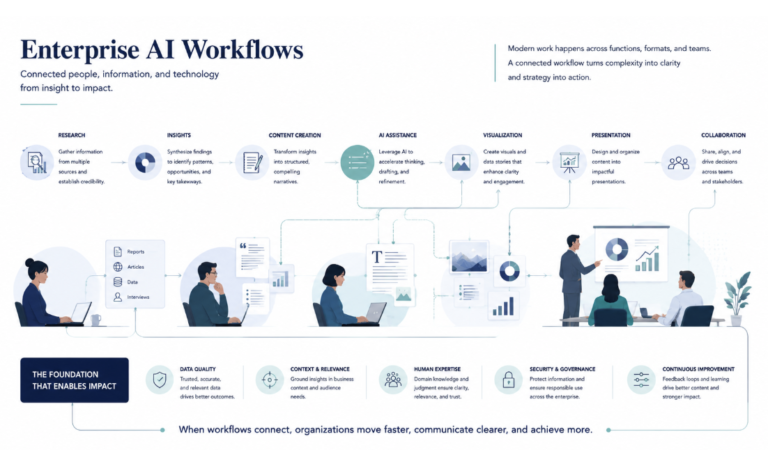
Enterprise AI is evolving from individual tools into connected workflows that help organizations move information from research to decisions.
For many organizations, adopting artificial intelligence was initially about improving individual tasks.
Employees used AI to draft emails faster. Teams experimented with automated summaries. Developers explored coding assistants. Marketing departments tested content generation. Business leaders investigated how AI could help reduce repetitive work and improve productivity.
These early applications created clear value.
However, as AI becomes more deeply integrated into everyday operations, organizations are beginning to encounter a different challenge.
The problem is no longer access to AI capabilities.
The problem is how those capabilities connect.
Modern employees rarely complete meaningful work inside a single application. A product manager researching customer feedback may need to analyze information, organize notes, write documentation, create a presentation, and communicate decisions to multiple teams. A consultant preparing a recommendation may move between research, analysis, reports, visual explanations, and client presentations before delivering the final outcome.
The work itself is connected.
The tools supporting that work often remain separate.
This gap is becoming one of the most important challenges in enterprise AI adoption.
Organizations now have access to more AI capabilities than ever before, but productivity gains increasingly depend on how effectively those capabilities work together.
The next phase of enterprise AI will not simply be about giving employees more tools.
It will be about reducing the friction between those tools.
The AI Adoption Paradox
The first generation of enterprise AI focused heavily on capability.
Organizations wanted to understand what AI could do and where it could create immediate value. The easiest starting point was individual tasks that consumed significant time but required predictable processes.
Writing a first draft.
Summarizing a document.
Generating ideas.
Creating simple reports.
Finding information.
These use cases demonstrated the potential of AI, but they also revealed an important limitation.
Business workflows rarely consist of individual tasks.
A marketing campaign does not begin and end with writing.
A product launch does not depend only on generating content.
A customer proposal is not complete when a document is created.
Each activity exists as part of a broader sequence.
Research leads to analysis.
Analysis leads to recommendations.
Recommendations become presentations.
Presentations create discussions.
Discussions lead to decisions.
The value of AI increasingly depends on how well it supports the entire journey rather than one individual moment.
This is where many organizations are beginning to rethink their approach.
The question is shifting from:
“Which AI tool should employees use?”
to:
“How can AI support the way employees already work?”
Context Switching Is Becoming The New Productivity Bottleneck
For decades, enterprise software has been organized around specific functions.
One platform manages documents.
Another handles presentations.
Another supports collaboration.
Another manages customer information.
Another stores organizational knowledge.
This structure made sense when software capabilities were limited.
However, modern knowledge work rarely follows those boundaries.
An employee may start with research in one application, organize thoughts in another, create content somewhere else, prepare visuals in a separate tool, and eventually share the final output through another platform.
Each individual step may feel efficient.
The overall workflow often does not.
Context switching creates hidden costs.
Employees spend time moving information between systems, recreating background information, adjusting formats, and ensuring that important details are not lost between different stages of work.
These interruptions are particularly challenging for enterprise teams because many workflows involve multiple people and departments.
A product team may need input from engineering, marketing, sales, and customer support before making a decision.
A communications team may need to transform internal information into customer-facing messaging.
A leadership team may need research, analysis, and presentations before making strategic decisions.
In each case, the challenge is not simply completing tasks.
It is maintaining context while information moves through the organization.
Enterprise AI Is Moving From Tools To Workflows
This is why the enterprise AI landscape is gradually moving beyond standalone tools.
Organizations are increasingly looking for environments where information can move naturally between different stages of work.
A modern workflow may begin with research, continue through brainstorming and drafting, move into refinement and review, and eventually become a presentation, customer communication, or internal resource.
The goal is not to eliminate every individual application.
It is to reduce unnecessary friction between them.
This shift is already visible across the technology industry.
Microsoft is embedding AI throughout workplace environments where employees already create documents, communicate, and collaborate. Google continues integrating AI capabilities across productivity and knowledge tools. Adobe is connecting creative workflows through AI-powered features across its ecosystem. Notion is combining documentation, collaboration, and AI assistance within shared workspaces.
These developments reflect a broader change in how organizations think about productivity.
AI is becoming less like an additional application employees open when they need assistance.
It is becoming part of the environment where work happens.
Communication Is Becoming The Connecting Layer
Although enterprise AI is expanding into many areas of business, one common theme connects most modern workflows.
Communication.
Research eventually becomes documentation.
Documentation becomes presentations.
Presentations become discussions.
Discussions become decisions.
Decisions become action.
This is why communication is becoming one of the most important layers in enterprise AI adoption. Organizations are not simply looking for systems that can generate information. They need systems that help employees transform information into something others can understand and use.
This shift is changing how professionals approach everyday work.
A product manager may need to understand customer feedback, organize findings, explain priorities, and communicate decisions across multiple teams. A consultant may need to transform research into recommendations that executives can quickly understand. A marketing team may need to connect campaign strategy, creative assets, reporting, and stakeholder communication into one consistent process.
The common challenge is not creating more information.
It is moving information effectively.
This is where connected AI workflows are becoming increasingly important.
Many professionals now begin projects by organizing ideas, exploring possibilities, and structuring information before creating final deliverables. An AI Chat workflow can support this early stage by helping users brainstorm concepts, analyze information, clarify objectives, and develop stronger communication before moving into drafting and refinement.
The value is not simply faster content creation.
It is helping teams create better decisions before those decisions become documents, presentations, or business outcomes.
The Rise Of AI-Powered Communication Workflows
As organizations mature their AI adoption, they are beginning to recognize that content creation is only one stage of a much larger process.
A first draft rarely represents the finished output.
Business communication requires review, refinement, adaptation, and presentation before it reaches its intended audience.
A strategy document may need to become an executive presentation.
A research report may need to become customer-facing communication.
An internal update may need to be adapted for different teams.
This is why workflows are becoming more valuable than individual features.
A platform that understands how information moves through an organization can provide more value than a collection of disconnected tools, even if each individual tool performs its task effectively.
This shift is influencing how companies design AI products.
The focus is moving away from isolated capabilities and toward systems that preserve context as work progresses.
The next generation of enterprise AI will focus on reducing friction between connected stages of work.
Why Enterprise AI Needs More Than Automation
Automation has always been an important part of technology adoption.
Businesses have used software to reduce repetitive work, improve accuracy, and increase efficiency for decades.
However, enterprise AI introduces a different opportunity.
The greatest value may not come from automating individual actions.
It may come from improving the entire journey between ideas and outcomes.
Consider a typical enterprise workflow.
A team researches a market opportunity.
The findings become a strategy document.
The strategy becomes a presentation.
The presentation creates alignment across stakeholders.
The final decision becomes communication for employees, customers, or partners.
Each stage depends on the previous one.
When context is lost between these stages, organizations spend more time recreating information than improving it.
AI workflows can help reduce this friction by allowing information to move more naturally across different formats and teams.
Visual Communication Is Becoming Part Of Enterprise Work
Another major shift taking place is the growing role of visual communication.
For many years, visual creation was considered a specialized function handled primarily by designers. Today, visuals have become part of everyday enterprise communication.
Sales teams use visual explanations during customer conversations.
Product teams create diagrams to communicate new concepts.
Marketing teams develop campaign assets across multiple channels.
Training teams use visuals to make complex information easier to understand.
As organizations become more dependent on visual communication, the ability to create and adapt visual assets is becoming part of everyday knowledge work.
Many professionals now use an AI Presentation Maker to transform research, meeting notes, business plans, and strategic ideas into structured presentations that help teams communicate more effectively. The purpose is not simply creating slides faster. It is ensuring that information moves from analysis to understanding without unnecessary manual reconstruction.
This represents a broader change in how enterprises think about communication.
Documents, visuals, presentations, and collaboration are no longer separate outputs.
They are connected stages of the same workflow.
Quillbot And The Evolution Of AI Communication Platforms
This broader transition can also be seen in the evolution of AI communication platforms.
Platforms such as Quillbot reflect the movement from individual productivity tools toward connected communication workflows. What began with writing assistance has expanded into a broader ecosystem where brainstorming, drafting, refinement, verification, and content creation support the complete communication process.
The significance of this shift is not simply that platforms are adding more capabilities.
It is that organizations increasingly need technology that understands the relationship between those capabilities.
The future of enterprise AI will not be defined only by what individual systems can accomplish.
It will be defined by how effectively those systems help people move from one stage of work to the next.
What Enterprises Should Consider Next
As AI adoption continues, organizations will increasingly need to think about workflows rather than tools.
The important questions will become:
How does information move through the organization?
Where are employees losing context?
Which processes require repeated manual effort?
How can teams communicate decisions more effectively?
These questions are becoming more important because enterprise productivity is rarely limited by access to information.
It is limited by the ability to transform information into action.
The organizations that benefit most from AI will likely not be those that deploy the largest number of applications.
They will be those that create connected environments where employees can research, communicate, collaborate, and execute with fewer interruptions.
The Future Of Enterprise AI
The next stage of enterprise AI will be defined by integration.
AI systems will continue becoming more capable, but capability alone will not determine success. The most valuable platforms will be those that understand context, support collaboration, and help organizations move information through complex workflows.
The competitive advantage will shift away from owning individual AI features.
It will move toward owning the workflow experience.
The future of enterprise AI will not simply be about helping employees complete tasks faster.
It will be about helping organizations communicate ideas, make decisions, and execute strategies more effectively.
The companies that succeed will not necessarily have the most AI tools.
They will have the most connected workflows.
