
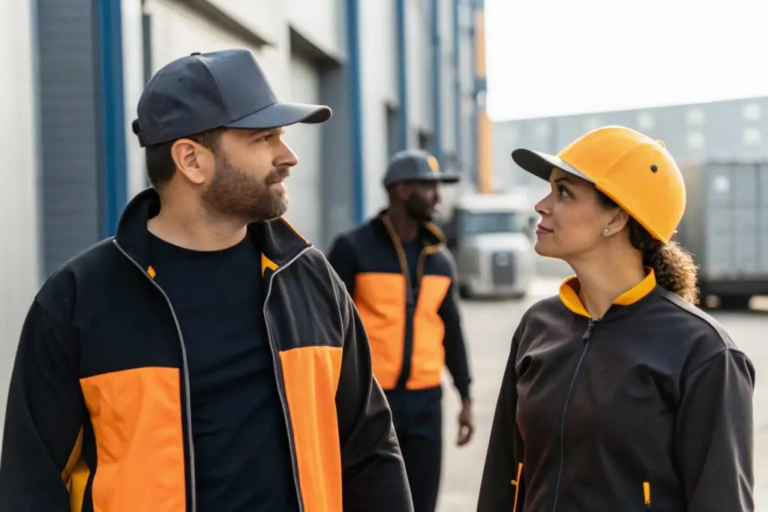
Recent industry data indicates that companies with a unified staff appearance see a 22 percent increase in customer trust and brand recognition. Many procurement officers face the recurring headache of receiving retail clothing orders that vary in shade or fail after six months of industrial laundering. This inconsistency erodes the professional image and leads to wasted capital on frequent replacements. Transitioning to b2b custom uniform production enables a brand to control every aspect of their identity while ensuring garments meet the specific physical demands of the workplace. This article provides a technical comparison of the two procurement paths to help businesses secure high-quality corporate apparel that lasts.
Main Takeaways
Large-scale operations require a focus on continuity and durability that retail stores simply cannot match. Wholesale uniform suppliers offer technical fabrics designed for the heat and friction of industrial environments. Custom corporate workwear manufacturing moves beyond basic logos, allowing for deep design integration and functional modifications. Strategic procurement involves understanding the Total Cost of Ownership (TCO) rather than just the initial unit price. Compliance with safety standards like ISO or NFPA is typically only available through specialized production cycles rather than off-the-shelf retail products.
Customization and Design Flexibility in Manufacturing
Standard retail ordering restricts a brand to existing color palettes and silhouettes curated by a fashion designer for the general public. If a retail brand decides to discontinue a specific shade of navy, a company is forced to find a new supplier, resulting in a fragmented team appearance. In contrast, custom corporate workwear manufacturing allows for exact Pantone color matching. This ensures that every shirt, jacket, and pant matches the official brand identity precisely across every production run, year after year.
Integrated Branding vs Surface Application
Retail ordering usually involves buying finished garments and sending them to a local shop for surface-level branding. This process is limited because embroidery machines cannot reach certain areas of a pre-sewn shirt, such as the collar tips or over seams. In professional production environments, personalized staff uniforms are constructed from the ground up. Logos can be screen-printed or embroidered onto panels before they are sewn together, allowing for creative placements and higher-quality finishes that do not pucker the fabric.
Functional Modifications for Work Environments
A retail shirt is designed for aesthetics, not necessarily for a technician reaching overhead or a warehouse worker moving heavy crates. Professional production allows for the addition of gusseted underarms, reinforced elbows, or hidden pockets for specific tools. Manufacturers can select specialized thread like Core Spun Polyester for higher seam strength, which prevents the embarrassing blowouts often seen in lightweight retail garments during physical tasks.
Scaling and Order Volume Management
Relying on retail inventory for a workforce of 500 people is a logistical nightmare. Retailers manage stock based on seasonal trends and consumer demand, often leaving bulk branded apparel buyers with incomplete size runs. When a business needs 50 Extra Large shirts and the retailer only has 10 in stock, the procurement process stalls. B2B production solves this through dedicated manufacturing slots where the entire volume is produced simultaneously, ensuring every employee receives the correct size in the same fabric weight.
The Role of Minimum Order Quantities
Production facilities operate on Minimum Order Quantities (MOQs) because setting up the looms and dye vats for specific fabrics requires significant overhead. While retail offers the convenience of buying a single item, bulk branded apparel production rewards volume with significant price breaks. MOQs ensure that the factory can source high-grade materials in bulk, passing those savings down to the client while maintaining a high standard of quality control that is often absent in mass-produced retail goods.
Continuity and Long Term SKU Availability
A common issue with retail sourcing is the “seasonal refresh.” Retailers change their collections every three to six months. If a company hires ten new employees in the fall, the summer uniform they purchased in May might be gone forever. Professional manufacturers maintain the technical specifications (tech packs) for a brand. This means five years from now, a business can order the exact same garment with the same fit and fabric, maintaining a cohesive corporate image indefinitely.
Material Quality and Industrial Durability
Retail garments are typically made for light wear and home laundering. They use fabrics with a lower Grams per Square Meter (GSM) count, making them feel soft but prone to thinning and pilling. Industrial uniform production prioritizes high-tenacity fibers and dyes that withstand the harsh chemicals and high temperatures of industrial washing machines. Fabrics are often treated with soil-release finishes or antimicrobial coatings that remain effective through dozens of wash cycles.
Technical Specifications and Fabric Selection
Manufacturing partners provide detailed data sheets for fabrics, covering tensile strength, color fastness, and shrinkage rates. While a retail shirt might shrink 5 percent after the first wash, a custom-manufactured garment is often pre-shrunk or constructed with fabrics that have a shrinkage tolerance of less than 2 percent. For businesses in the service or industrial sectors, choosing a 240 GSM poly-cotton twill over a standard 140 GSM retail poplin can double the lifespan of the uniform.
Sizing Inclusivity for Diverse Workforces
Retailers focus on the “bell curve” of sizing, often ignoring the needs of very tall or plus-size employees. This forces some staff members to wear ill-fitting clothes that look unprofessional. B2B production allows for extended sizing and bespoke measurements. Every team member, regardless of body type, receives a uniform that fits properly, which improves morale and safety on the job site.
Comparing Materials and Procurement Metrics
Deciding between retail and custom production requires a look at how different materials perform under stress. Retail options often lean toward 100 percent cotton for comfort, but this lacks the durability needed for corporate clothing solutions in high-activity roles. Professional manufacturers typically recommend blends or specialized synthetics for better longevity and color retention. Use the following table as a quick reference when deciding between materials based on performance and long-term cost-effectiveness.
Material Performance Comparison Table
| Fabric Type | Durability Rating | Color Retention | Breathability | Typical Use Case |
| Retail 100% Cotton | Low – Thins quickly | Poor – Fades in 10 washes | High – Very airy | Temporary event shirts |
| 65/35 Poly-Cotton Twill | High – Industrial grade | Excellent – Vat dyed | Medium – Good for labor | Industrial workwear |
| Moisture-Wick Polyester | Medium – Snag resistant | Good – Sublimated | Very High – Stays dry | Active staff roles |
| Heavyweight Canvas | Very High – Tear proof | Moderate – Rugged look | Low – Stiff but tough | Heavy construction |
| Performance Pique | High – Holds shape | Very Good – High tech | High – Professional look | Corporate casual uniforms |
This table highlights that while retail cotton may be comfortable for a day, the technical blends used in bespoke business uniforms provide the structural integrity required for long-term daily use. Procurement managers should weigh the initial comfort against the reality of how the garment will look after six months of constant wear.
Unit Price vs Total Cost of Ownership
At first glance, a retail shirt might appear cheaper because there are no setup fees or development costs. However, this is a narrow view of the budget. A $20 retail shirt that needs replacement every four months costs $60 per year. A $35 custom-produced shirt that lasts eighteen months represents a significant saving. The Total Cost of Ownership (TCO) includes the price of the garment, the cost of the branding, and the frequency of replacement.
The Investment in Tech Packs and Prototyping
Custom production involves an initial investment in creating a tech pack, which is a blueprint for the garment. This includes measurements, material specs, and stitch types. While this adds a small upfront cost, it guarantees that the quality remains consistent across thousands of units. It eliminates the “surprise” of receiving a batch of shirts with crooked pockets or inconsistent sizing, which is a common risk when buying bulk from retail outlets.
Bulk Discounts and Tiered Pricing
Wholesale uniform suppliers offer tiered pricing that retail stores cannot match. In retail, you pay the shelf price regardless of whether you buy five or fifty items. In B2B manufacturing, the price per unit drops significantly as the volume increases. For a company ordering for a large workforce, these economies of scale can offset the costs of customization entirely, resulting in a superior product for a lower price than basic retail alternatives.
Lead Times and Strategic Supply Chain Planning
Retail ordering is designed for immediate gratification. You walk into a store or order online, and the product arrives within days. However, this relies on the retailer’s ability to manage their own stock. If they run out, your uniform program stops. B2B production requires more lead time—typically 8 to 14 weeks—but it offers a more stable supply chain because the production is dedicated specifically to your brand.
Seasonal Ordering and Warehouse Services
Professional manufacturers often provide inventory management services. Instead of receiving 5,000 shirts at once, a company can have the manufacturer store the stock in a warehouse and ship it out as new hires join. This “on-call” delivery combined with scheduled production cycles allows for a seamless flow of uniforms without the need for the business to manage its own large-scale storage facility.
Prototyping and Quality Assurance
The manufacturing process includes a sampling phase where a physical prototype is sent to the client for approval. This allows the business to test the fit and fabric in a real-world environment before the full order is produced. Retail ordering does not offer this level of quality assurance; you are essentially stuck with whatever the brand has produced for that season, regardless of how it performs in your specific work environment.
Compliance and Safety Standards in Production
For industries like electrical work, oil and gas, or heavy construction, uniforms are more than just clothing; they are Personal Protective Equipment (PPE). Standard retail clothing rarely meets the stringent safety certifications required for these sectors. Industrial uniform production ensures that garments meet specific standards such as Flame Resistance (FR), Arc Flash protection, or high-visibility requirements (ANSI/ISEA 107).
Direct Adherence to Industry Regulations
When working with a custom manufacturer, you can specify exactly which safety standards the fabric must meet. The manufacturer provides the necessary documentation and certifications for each batch. This is critical for corporate liability and employee safety. Retail garments often lack these certifications, and even if a retail item looks like a safety vest, it may not actually meet the legal requirements for a construction site or roadway work.
Ethical Sourcing and CSR Transparency
Modern businesses are increasingly held accountable for the ethics of their supply chain. B2B manufacturers provide transparency into where their fabrics are sourced and the conditions of the factories where the clothes are sewn. This allows a company to uphold its Corporate Social Responsibility (CSR) goals, ensuring that its uniforms are produced without exploitative labor practices—a level of transparency that is often difficult to verify with mass-market retail brands.
Recap
Custom uniform manufacturing provides absolute control over brand identity through Pantone matching and integrated logo placement. Industrial-grade materials used in professional production outlast retail fabrics by a factor of three to one in high-wear environments. While lead times are longer for custom orders, the long-term cost of ownership is lower due to increased durability and bulk pricing. Manufacturers offer size inclusivity and safety compliance that retail stores cannot provide. Strategic inventory management and dedicated production cycles ensure that a brand never suffers from seasonal stock shortages.
FAQs About b2b custom uniform production
How does custom production ensure color consistency?
Unlike retail stores that change dye lots every season, professional manufacturers use lab-dipped Pantone matching. This means the chemical composition of the dye is recorded and replicated for every order, ensuring the brand’s signature colors remain identical across different garments and years.
What is the typical lifespan of a custom-manufactured uniform?
A high-quality custom uniform made with industrial-grade fabrics like poly-cotton twill or performance pique is designed to last 50 to 75 industrial wash cycles. In contrast, retail garments often begin to show significant wear, fading, or structural failure after only 15 to 20 washes.
Is custom manufacturing more expensive than retail?
While the initial unit price and setup fees may be higher, custom manufacturing is more cost-effective in the long run. The increased durability reduces the frequency of replacements, and bulk discounts significantly lower the per-unit cost for large teams compared to retail markups.
Can MFG Merch help me select the right fabric for my brand?
Yes, MFG Merch acts as a technical consultant to help brands navigate the complexities of fabric weights, fiber blends, and safety certifications. Their expertise ensures that the selected materials align with the specific physical demands of the workplace while staying within budget. They provide guidance on everything from GSM selection to the best branding methods for longevity.
What is the minimum number of items for a custom order?
Minimum order quantities vary depending on the complexity of the design and the type of fabric requested. Most professional production facilities require at least 50 to 100 units per style to make the setup of specialized machinery and dye vats economically viable for the client.
