
When a plastic component includes a metal insert, requires controlled positioning, or needs an efficient molding setup within limited floor space, machine configuration becomes an important production decision. A vertical injection molding machine is designed around these requirements, using an upright mold arrangement rather than the horizontal layout found on many conventional injection molding machines.
The vertical configuration can simplify insert placement and part handling while supporting the same fundamental injection molding cycle: plastic is prepared, injected into a mold, cooled, and then removed as a finished component.
What Is a Vertical Injection Molding Machine?
A vertical injection molding machine is an injection molding system in which the mold is arranged vertically. The machine uses an injection unit to prepare and inject molten plastic while a clamping system holds the mold closed during the process.
The basic principle remains similar to other injection molding equipment. Plastic material is heated until it becomes suitable for injection, pushed into the mold cavity, allowed to cool, and then removed.
What makes the vertical configuration different is the orientation of the mold and the way operators or automation systems can access the molding area. This arrangement can be particularly useful for applications involving inserts or components that must be positioned before molding.
How Does the Injection Molding Process Work?
The molding cycle consists of several coordinated stages.
1. Material Preparation
Plastic pellets are introduced through a hopper into the injection unit. Inside the heated barrel, the material is softened and plasticized by heat and the mechanical action of the screw.
The resulting molten plastic must have suitable temperature and flow characteristics before injection. Material selection and processing conditions can influence the final part quality.
2. Mold Closing and Insert Placement
Once the material is ready, the mold closes around the cavity. For insert molding applications, components such as metal pins, terminals, or other preformed parts can be positioned in the mold before plastic injection.
The vertical arrangement can make insert placement convenient because the mold area is accessible from above. Inserts may be positioned manually or with automated equipment, depending on the production setup.
3. Plastic Injection
The screw pushes the molten plastic through the nozzle and into the mold cavity. The material fills the cavity and takes the shape defined by the mold.
Injection pressure, speed, material temperature, mold design, and other process parameters must be properly controlled. Poorly matched settings can contribute to issues such as incomplete filling, flash, warping, or dimensional variation.
4. Cooling and Solidification
After the cavity has been filled, the plastic begins to cool and solidify. Cooling is an important part of the cycle because the molded component needs sufficient stability before the mold opens.
The required cooling conditions depend on factors such as the material, part thickness, mold design, and production requirements.
5. Mold Opening and Part Removal
Once the molded part has reached the required condition, the mold opens and the component is removed. Part removal can be performed manually or with automation, depending on the machine and production line.
This completes the primary molding cycle before the machine prepares for the next shot.
Why Use a Vertical Configuration?
One of the main reasons manufacturers consider vertical injection molding is its suitability for insert molding. The upright mold arrangement can make it easier to position inserts before the mold closes, helping reduce unwanted movement during injection.
Vertical machines can also make efficient use of factory floor space in suitable installations. The actual footprint depends on the machine design, auxiliary equipment, mold dimensions, and automation arrangement, so space requirements should be evaluated for the complete production cell rather than the machine alone.
Another consideration is operator and automation access. Depending on the configuration, the vertical layout can provide convenient access to the molding area for inserting components or removing finished parts.
Insert Molding and Overmolding Applications
Insert molding is one of the most relevant applications for vertical injection molding. The process involves placing an existing component inside the mold and then injecting plastic around it.
For example, a manufacturer may mold plastic around a metal component to create an integrated assembly. Applications can include electrical connectors, terminals, automotive components, and other metal-plastic parts.
Overmolding follows a related concept, with one material molded over an existing component or substrate. However, not every vertical injection molding machine is automatically suitable for every insert or overmolding application. The machine, mold, material, and insert geometry must be evaluated together.
Materials and Part Quality
Vertical injection molding machines can be used with suitable thermoplastic materials, but compatibility depends on the machine’s configuration and the material being processed.
Common engineering and general-purpose plastics may include PP, ABS, PA, PC, POM, and certain flexible materials. Each material has its own processing requirements, including temperature range, flow behavior, cooling characteristics, and mold considerations.
Consistent part quality also depends on more than the machine. Mold design, injection settings, material preparation, cooling, clamping performance, and machine maintenance all contribute to the final result.
Manufacturers should therefore establish appropriate process parameters through proper testing and follow the material and machine manufacturer’s recommendations.
Automation With Vertical Injection Molding
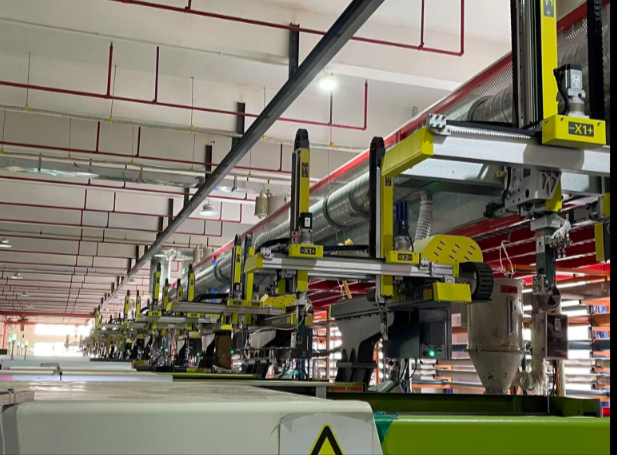
Automation can extend the capabilities of a vertical molding cell. Depending on the application, robots can assist with insert placement, finished-part removal, material handling, or transfer to a conveyor.
Samfacc’s automation solutions include vertical robots designed for vertical injection molding applications. The company describes configurations intended to remove finished products or material heads and transfer them to conveyors, while also emphasizing space utilization and reduced manual handling.
Automation is particularly useful when production involves repetitive insert placement or part removal. The appropriate robot, however, should be selected according to mold geometry, cycle requirements, part weight, available space, and the desired workflow.
How to Choose the Right Machine
Selecting a vertical injection molding machine should begin with the part and mold rather than the machine alone.
Manufacturers should consider:
- Required clamping force
- Mold dimensions
- Part size and geometry
- Plastic material
- Required shot size
- Insert-molding requirements
- Production volume
- Automation needs
- Available factory space
- Operator access
- Maintenance requirements
- Future production plans
If the application involves inserts, buyers should also discuss insert dimensions, positioning methods, mold design, and whether manual or robotic loading is appropriate.
It is useful to provide the manufacturer with actual part drawings, material information, mold details, and production targets before selecting the final machine configuration.
Maintenance and Safe Operation
Regular maintenance helps keep the molding process stable. Operators should follow the manufacturer’s maintenance schedule and monitor components such as the heating system, screw, sensors, mold area, and other machine systems.
Cleaning is also important because accumulated material can interfere with machine operation. Any servicing involving electrical, hydraulic, heating, or moving systems should follow the manufacturer’s instructions and be handled by appropriately trained personnel.
Safety features and operator procedures should be treated as part of the complete production setup, particularly because injection molding involves heat, pressure, and moving machine components.
Final Thoughts
A vertical injection molding machine follows the fundamental principles of injection molding but uses an upright mold arrangement that can offer practical benefits for specific manufacturing applications. Its configuration is particularly relevant to insert molding, where stable component placement is an important part of the process.
For manufacturers evaluating vertical molding equipment, the decision should be based on the part, mold, material, production volume, automation requirements, and available workspace. A properly matched machine and mold system can provide a practical foundation for consistent plastic-component production without assuming that one configuration suits every application.
