
For wineries and beverage producers, corking is a small part of the overall bottling process, but it can have a direct impact on production consistency. Manually inserting corks becomes increasingly difficult when bottle volumes grow, particularly when the same production line also includes filling, labeling, and other packaging stages.
A wine corker automates the process of feeding and pressing corks into bottles. The right equipment, however, depends on bottle dimensions, cork specifications, production volume, and how the corking machine needs to interact with the rest of the bottling line.
What Does a Wine Corker Do?
A wine corker is designed to position and press a cork into a bottle in a controlled and repeatable manner. In an automated system, the machine can handle bottle positioning, cork loading, and cork pressing with less manual intervention.
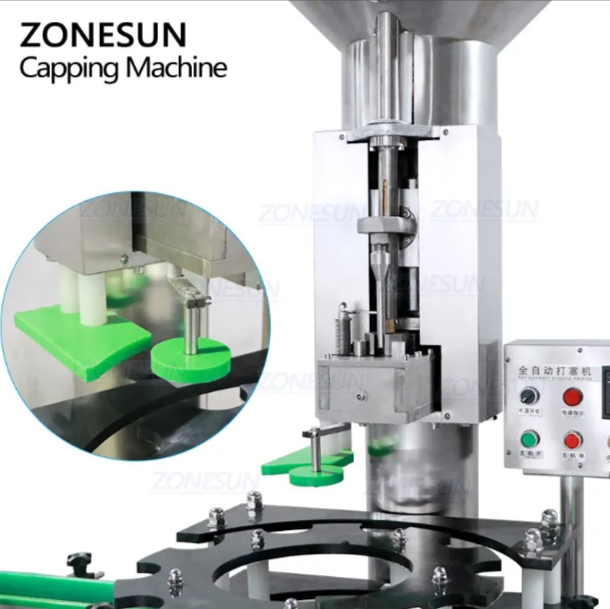
The ZONESUN ZS-DSJ2, for example, is an automatic wine bottle corker with a cork-feeding structure. Its system is designed to load and press wine corks automatically, while a micro switch prevents corking when a bottle is not correctly positioned under the corking mechanism.
This type of bottle-detection feature is useful because it helps coordinate the corking operation with the movement of bottles through the machine.
How Does an Automatic Wine Corker Work?
The exact operating sequence varies by machine, but a typical system follows several stages.
Empty or filled bottles are transported into the corking area. Corks are supplied through a hopper or feeding structure and positioned for insertion.
As a bottle reaches the corking station, the machine aligns the bottle and presses the cork into its opening. A star wheel can help guide and position bottles during this process.
The ZS-DSJ2 uses a star wheel that can be customized according to bottle requirements. Its conveyor system can also be adjusted to suit production needs.
Once corking is complete, the bottle can continue to the next stage, such as labeling or other packaging operations.
Why Bottle and Cork Compatibility Matters
A wine corker cannot be selected independently of the bottle and cork.
Bottle diameter, bottle height, neck dimensions, and cork size can all affect machine setup. The cork must also be appropriate for the bottle and intended application.
For the ZS-DSJ2, the listed cork diameter is 20–24 mm and cork height is 35–50 mm, while the applicable bottle diameter is listed as 55–95 mm. These dimensions are presented as customizable according to requirements.
This is why buyers should provide actual bottle and cork specifications to the manufacturer before finalizing a machine configuration.
Cork Feeding Can Reduce Manual Handling
One of the practical challenges in automated corking is maintaining a consistent supply of corks. Operators may otherwise need to repeatedly load corks into the machine.
An automatic cork-feeding system can reduce this repetitive work by supplying corks to the hopper. ZONESUN’s wine corker can be equipped with a feeding machine that automatically conveys corks into the hopper when continuous supply is required.
The appropriate feeding arrangement depends on production volume and machine configuration. Smaller operations may have different requirements from high-volume bottling lines.
Integrating a Wine Corker With Other Equipment
A corker is often only one stage in a larger bottling process.
A typical wine bottling workflow may include:
- Bottle filling
- Corking
- Additional sealing or film treatment where required
- Labeling
- Case packing
Integrating these stages can reduce unnecessary manual handling between machines. ZONESUN states that its wine corker can work with filling machines, labeling machines, and film-shrink equipment to support an automated production line.
For manufacturers planning a complete line, compatibility between conveyors, bottle positioning, machine controls, and production speeds should be evaluated before installation.
What Should Buyers Consider When Selecting a Wine Corker?
Production requirements should drive the equipment selection.
Start with the bottle. Measure the bottle diameter, height, and neck dimensions that the machine will need to accommodate. Then determine the cork’s diameter, height, and type.
Production volume is another major consideration. A small winery may prioritize a compact and flexible setup, while a larger producer may require automated cork feeding and a higher-throughput configuration.
The physical layout of the production area also matters. Conveyor length, machine dimensions, access for operators, and space for maintenance should be considered before installation.
Buyers should also ask whether the star wheel, cork-feeding system, pressing components, and conveyor can be customized for their specific bottles.
What About Champagne, Rum, and Other Bottled Beverages?
Not every bottle-corking system is designed for the same closure.
Standard wine corking and sparkling-wine corking can involve different requirements. ZONESUN, for example, also offers equipment specifically designed for sparkling wine and champagne applications, including systems that handle mushroom corks and muselets.
The target ZS-DSJ2 machine is presented primarily for wine corking, while the manufacturer also identifies applications involving champagne and rum on its related product information. Buyers should therefore confirm the exact bottle and cork type before selecting equipment.
Maintenance and Operator Considerations
Regular maintenance helps keep an automated corking system operating consistently.
Operators should follow the manufacturer’s maintenance schedule and keep relevant machine areas clean. Components involved in bottle positioning, cork feeding, and pressing should be inspected according to the equipment instructions.
Detachable components can also make routine maintenance more manageable. The manufacturer states that the ZS-DSJ2 is designed with detachable parts to facilitate maintenance.
For installation, adjustment, or technical servicing, manufacturers should follow the machine manual and use appropriately trained personnel.
Questions to Ask the Manufacturer
Before purchasing a wine corker, buyers should clarify:
- What bottle dimensions can the machine handle?
- Which cork types and sizes are supported?
- Can the star wheel be customized?
- Is automatic cork feeding available?
- Can the machine connect with an existing filler and labeler?
- What production capacity is appropriate for the intended line?
- What changes are required for different bottle formats?
- What maintenance is required?
- Is installation or operator training available?
- Can the machine be tested with the actual bottles and corks?
Testing is particularly useful when bottles or closures have unusual dimensions.
Final Thoughts
Choosing a wine corker is ultimately about matching the corking system to the bottle, closure, and production workflow. Bottle dimensions, cork specifications, production volume, automation, and integration with other equipment all influence the appropriate configuration.
For wineries and beverage manufacturers moving toward automated bottling, a properly configured corking machine can reduce repetitive manual handling and create a more consistent transition between filling and downstream packaging. The most reliable approach is to discuss the actual bottles, corks, and production requirements with the manufacturer before selecting the final machine configuration.
