
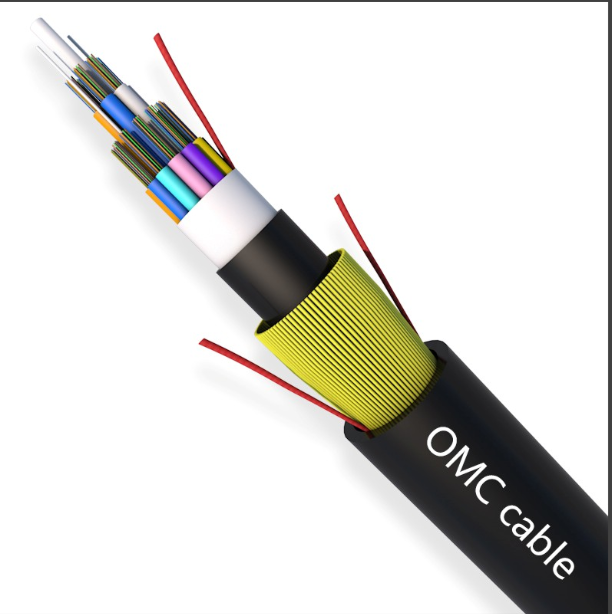
ADSS fiber optic cable is an optical cable that is required for the installation of a fiber network in the air without using any metallic messenger cable for support. ADSS stands for All Dielectric Self Supporting.
Such a cable is widely used in telecommunications and broadband networks. Being made of non-metallic materials, it may be applied for routes located close to electric devices. Also, the self-supporting feature makes the installation process easier.
What Is an ADSS Fiber Optic Cable?
An ADSS fiber optic cable is an aerial fiber cable that does not contain any metallic elements. Instead, it has dielectric materials with a supporting design allowing the cable to be installed between poles or other supporting structures.
The cable consists of optical fibers enclosed in loose tubes, fillers, strength members, and an external sheath. The design of the cable depends on specific requirements.
In contrast to traditional aerial fiber cables requiring separate messenger cables, ADSS cable is self-supporting.
How Does ADSS Fiber Optic Cable Work?
The optical fibers that exist in an ADSS cable communicate data through pulses of light.
The cable itself serves to protect these optical fibers against mechanical and environmental strain.
Strength members assist in allowing the cable to deal with its own weight and the tension that results during the installation of the cable in an overhead manner.
Due to the all-dielectric nature of the cable, no conductive metallic parts exist within the cable.
Key Benefits of ADSS Fiber Optic Cable
Self-Supporting Design
One of the main benefits of ADSS is its self-supporting structure.
The cable can be installed on aerial routes without relying on a separate metallic support wire. This can simplify certain installation designs and reduce the number of components required for an aerial span.
All-Dielectric Construction
ADSS cables do not use metallic conductors as their primary supporting elements.
This makes them suitable for many installations where electrical conductivity needs to be avoided. It can be particularly useful when fiber routes are positioned near power infrastructure.
Suitable for Aerial Networks
ADSS cable is specifically designed for overhead deployment.
It can be installed along utility poles and other aerial infrastructure. Its suitability for a particular route depends on span length, wind, ice loading, sag, temperature, and other environmental conditions.
Protection for Long-Term Deployment
A properly designed ADSS cable can withstand different environmental stresses.
The cable construction can be selected according to factors such as mechanical load, UV exposure, temperature variation, and expected aerial span.
However, cable selection should always be based on actual route conditions rather than general assumptions.
Efficient Network Expansion
ADSS can be useful when telecommunications networks need to extend along existing aerial infrastructure.
Using an appropriate self-supporting cable can help network operators deploy fiber along established pole routes without installing a separate metallic messenger system.
ADSS Fiber Optic Cable Applications
Telecommunications Networks
Telecom operators use aerial fiber to connect different parts of a communications network.
ADSS can provide a practical solution for overhead fiber routes where self-supporting installation is required.
Broadband Networks
Internet service providers can use aerial fiber to extend broadband infrastructure.
ADSS can be particularly useful in areas where underground construction is difficult, expensive, or impractical.
Utility Infrastructure
ADSS is also used on utility pole networks.
Its dielectric construction makes it suitable for certain routes near electrical infrastructure. Proper engineering is still required to maintain safe clearances and meet applicable installation requirements.
Rural Fiber Deployment
Rural areas often have long aerial routes between communities and network access points.
ADSS can support these deployments when the cable is correctly selected for the required span and environmental loading.
FTTH and Access Networks
ADSS can also be used as part of broader fiber access infrastructure.
It can provide an aerial distribution path before fiber is transitioned into other cable types closer to homes or buildings.
ADSS Cable Construction
An ADSS cable typically includes several structural components.
Optical Fibers
These optical fibers will provide the means through which the information will travel.
Single-mode fibers are normally used in long distance telecoms and broadband networks. Fiber chosen should be able to suit the transmission requirements of the network.
Loose Tubes
Optical fibers may be placed inside loose tubes.
These tubes help protect the fibers from external mechanical and environmental stresses while allowing the fibers some freedom of movement.
Strength Members
Strength members help the cable withstand mechanical forces.
In ADSS construction, these components are made from dielectric materials rather than metal.
Outer Sheath
The outer sheath protects the internal components from environmental exposure.
Depending on the cable design, the sheath can be engineered to withstand factors such as UV radiation, moisture, and temperature changes.
What Makes ADSS Different From Other Aerial Fiber Cables?
ADSS is different from aerial cables that depend on a separate messenger wire.
A conventional messenger-supported cable uses another structural component to support the optical cable. ADSS integrates its supporting capability into the cable itself.
This can simplify the overall aerial cable arrangement.
ADSS also differs from metallic aerial cables because its construction is dielectric. This characteristic makes it useful for certain telecommunications routes near electrical infrastructure.
ADSS vs. OPGW
ADSS and OPGW are both used in aerial fiber networks, but their applications are different.
ADSS is an all-dielectric cable that can be installed separately from the electrical conductor system.
OPGW, or Optical Ground Wire, combines optical fibers with the function of a grounding wire on electrical transmission infrastructure.
Therefore, the choice depends on the network and utility infrastructure. ADSS is generally considered when a separate dielectric fiber cable is required, while OPGW is integrated into suitable electrical transmission systems.
How to Choose the Right ADSS Fiber Optic Cable
Consider Span Length
Span length is one of the most important factors.
The distance between supporting poles affects the mechanical requirements of the cable. Longer spans can require different cable constructions and greater mechanical strength.
Evaluate Environmental Loading
Wind and ice can place additional loads on aerial cables.
The cable should be selected according to the expected environmental conditions along the route.
Check Installation Temperature
Temperature changes can affect aerial cable behavior and sag.
The operating and installation temperature ranges should therefore be reviewed before selecting an ADSS cable.
Consider Sag and Tension
ADSS engineering involves more than simply selecting a cable with a high tensile rating.
Sag and tension calculations help determine whether the cable is suitable for a specific span. Pole spacing, cable weight, wind, ice, temperature, and installation conditions can all influence the final design.
Check Fiber Count
Choose a fiber count based on current network requirements and planned expansion.
Higher fiber counts may be useful for distribution routes, while smaller configurations can be suitable for other applications.
Installation Considerations
Proper ADSS installation requires careful planning.
Installers should follow the cable manufacturer’s recommended pulling tension, bend radius, sag, and installation procedures. The cable should not be exposed to mechanical loads beyond its specified limits.
Attachment hardware must also be compatible with the cable diameter and installation conditions.
Clearances are especially important when ADSS is installed near power infrastructure. The route should be engineered according to applicable electrical and telecommunications requirements.
Why Choose a Reliable ADSS Fiber Optic Cable Manufacturer?
ADSS cables are engineered products. Their performance depends on cable construction, fiber quality, mechanical design, environmental resistance, and correct installation.
A reliable manufacturer should provide clear technical specifications and cable configurations for different aerial requirements.
OMC Cable provides ADSS fiber optic cable solutions for aerial telecommunications applications. Its ADSS products are designed around different fiber counts, span requirements, and installation conditions. The company also provides technical information to help buyers select suitable cable configurations.
For a specific project, buyers should provide details such as span length, expected wind and ice conditions, installation temperature, fiber count, and pole configuration.
Frequently Asked Questions
What does ADSS stand for?
ADSS stands for All-Dielectric Self-Supporting. It is an aerial fiber optic cable designed to support itself without a separate metallic messenger wire.
Where is ADSS fiber optic cable used?
ADSS cable is commonly used in aerial telecommunications, broadband, utility corridors, rural fiber networks, and other overhead fiber deployments.
Is ADSS suitable near power lines?
Its all-dielectric construction makes ADSS suitable for certain installations near electrical infrastructure. However, proper engineering, clearance, and installation practices are essential.
What factors affect ADSS cable selection?
Important factors include span length, fiber count, wind and ice loading, temperature, sag, tension, pole configuration, and installation environment.
Does ADSS cable contain metal?
No. ADSS is designed as an all-dielectric cable. Its supporting components are made from non-metallic materials.
Conclusion
An ADSS fiber optic cable provides a practical solution for aerial fiber deployment where a self-supporting and non-metallic cable is required. Its dielectric construction and integrated mechanical support make it useful for telecom, broadband, rural, and utility-related fiber networks.
Selecting the right cable requires more than checking fiber count. All of the above factors need to be taken into account. Given that the correct engineering and installation are done, the ADSS cable will be able to form a sound base for aerial fiber optics.
