
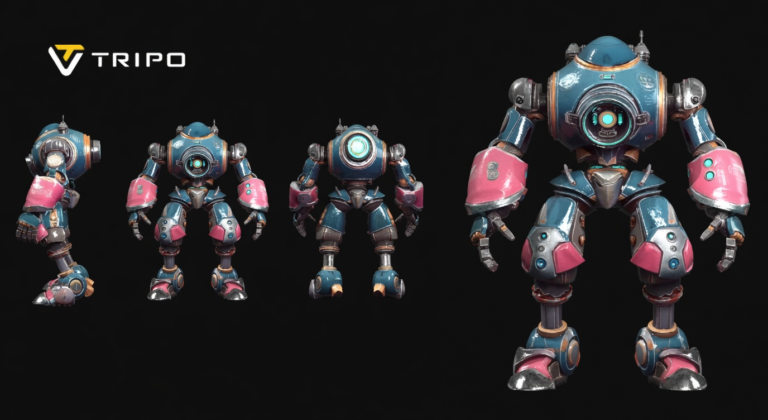
Fast, quality, and readily available 3D assets are more crucial than ever to the production of animation. The challenge is for studios and independent creators to keep production times low while keeping high visuals. Workflows tend to be time-consuming with traditional rigging and asset preparation. The process of creating the bones, assigning the skin weights, and testing is all resource and time-consuming. These complex steps are now automated and are part of today’s AI systems as pipelines. There are many tools available to help bring the ideas to life in the form of a model that can be quickly and efficiently animated, such as Tripo 3D.
Why Rigging Is Essential for Animation Pipelines
Rigging is the backbone of any animation pipeline and will be the deciding factor as to how a model will move. Skeleton structures are similar to a digital skeleton that controls the behavior of deformation and motion. Using the appropriate rigs, characters can be made to express emotion and natural movements. The relationship between mesh vertices and bones is known as Skin Weights, which determines how the mesh moves along with the bones. Poor weight distribution can contribute to incorrect geometry specially where the model contracts or expands. Manual rigs are technically challenging and time-consuming to develop. Artists need to make sure to test the behavior of the joints in a variety of poses. Rigs work well with animation programs and game engines as well. Even the best of models are static and can’t be used for storytelling if they aren’t rigged properly.
How AI Transforms Static Models into Animation-Ready Assets
The use of AI-based tools brings a revolution in the conversion of 3D models into animated parts. In seconds, the geometry is analyzed, and automated processes are used to create structured skeletons. Intelligent placement of joints, based on shape proportions and anticipated movement behavior. Weights are distributed evenly on the skin, which reduces the amount of error in the deformation during playback animation. These innovations cut down on manual adjustments and production time. Developers have a more streamlined experience and faster development cycles. This transformation is further boosted by the AI 3d model generator workflow in the modern platforms, which unifies the modeling, rigging, and animation preparation process. This approach will allow faster experimentation and better development of assets for different creative industries.
Tripo 3D Features That Support Rapid Rigging
Tripo 3D is a fully integrated environment, ready for rapid rigging and animation. AI-generated rigs automatically match skeletons with the model structure to help support realistic movement behavior. Exports are ready to be used in animation engines such as Unity and Unreal. Structured topology boosts the quality of deformations during complicated movements and interactions between characters. Fast turnaround of generations reduces waiting time between the different stages of design and output. Artists can easily move from conception to a rigged model without having to use an external tool. Support for integration with larger pipelines for game, film & interactive media production. The image-to-3D conversion capability adds value to asset creation by allowing visual references to be transformed into structured 3D models, ready for rigging and animation workflows.
Essential Components of High-Quality AI Rigging
- Skin Weighting is used to evenly distribute the influence of the mesh to give stable deformations.
- Balanced weighting minimizes visual artifacts when bending and stretching.
- Joint Placement determines the quality of articulation as well as improving the control of the direction of movement.
- The responsiveness is improved during dynamic animation and interactions, thanks to the strategic placement.
- Mesh Organization for clean topology to edit and rig stability.
- Structured meshes make for an easier pipeline when using animation software.
- Export Compatibility helps to make models compatible between platforms and engines.
Steps to turn ideas into rigs instantly with AI 3D model generator animation tools
Step 1: Concept Input and Rig Foundation Setup
- Access Tripo 3D after signup and open the “Model” tab.
- Choose “HD Model” for animation-ready structure generation.
- Upload an image using drag-and-drop or the “Upload” tab.
- Or switch to “Text to model” to generate rig-friendly assets from text ideas.
Step 2: Animation-Friendly Model Configuration
- Open “General settings” and activate “AI complete” for automatic structure building.
- Enable “PBR” for realistic material behavior during animation preview.
- Choose “Quad” topology for better rigging deformation or “Triangle” if needed.
- Adjust polycount for smoother animation performance.
- Select model version: v3.1 best quality, v3.0 balanced, or v2.5 legacy.
- Use “Generate in Parts” for complex character segmentation if available.
- Click “Generate Model” to build the asset.
Step 3: Rig Preview and Export for Animation
- Preview using “Solid View”, “Cartoon Style”, or “Unlit” to check deformation clarity.
- Use “Refine” to improve joint-friendly topology.
- Adjust “Environment Settings” and reposition with “Reset Camera”.
- Export via “Export”, choose a format and resolution suitable for animation pipelines.
From Character Concepts to Motion-Ready Assets
The quicker ideas can be turned into animated characters, the better for creative workflows. Initial sketches are transformed into formal 3D-models without any manual reconstruction delay. Concept to Animation pipelines are more efficient with automated processing tools. There is uniformity between design fidelity and production stages. The iterations happen more quickly, and you begin to test out varying styles of characters and ideas of movement. The text to 3d model feature enables the conversion of text to structured 3d assets for rigging and animation. This cuts down on the reliance upon conventional modeling and accelerates early development of games, film, and interactive media projects.
Integrating AI-Generated Rigs into Production Environments
AI-generated rigs seamlessly fit into various production workflows in different industries. Optimized assets are directly imported into the game engines for optimized performance and animation. Film pipelines benefit from quick character setup and less manual rigging. Applications for AR and VR are based on lightweight models that are optimized for real-time interaction. Scalable production workflows are organized by the models created and optimized for export to commonly used industry software. Standardization and automation readiness increase the efficiency of collaborative pipelines. This integration paves the path for faster turnaround time and innovative flexibility in various digital production disciplines.
Conclusion
AI revolutionizes rigging systems, reshaping animation asset creation and utilization. Automated workflows lower technical complexity and increase production speed. Tripo 3D allows ideas to be converted to usable animated models in a shorter time. Streamlined modeling, texturing, rigging, and export in one environment with integrated tools. Helps to save creative industries from unnecessary burden and quick iteration. Intelligent automation is still influencing the future of animation production.
