
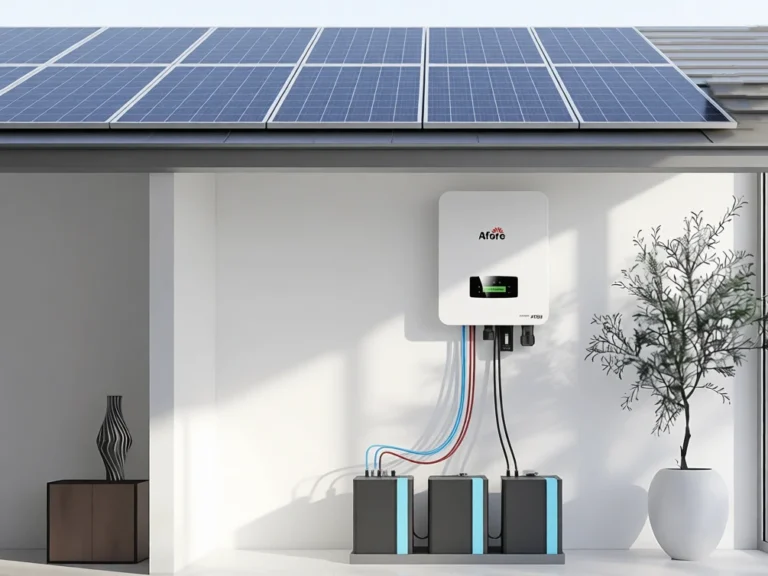
A 50kW hybrid inverter usually enters the conversation when a project has already outgrown the “typical rooftop solar” stage. It’s the point where energy stops being just about offsetting a bill and starts becoming part of operational planning—how a building runs during outages, how peak demand is controlled, and how battery systems are actually integrated into daily load behavior.
In many U.S. commercial and light industrial setups, buyers first look at panels and batteries separately. Only later does the inverter become the bottleneck—or the enabler. The 50kw Hybrid Inverter sits right in that middle ground, coordinating solar production, battery storage, and grid interaction in a way that directly affects performance stability and payback expectations.
One thing many buyers overlook is that this size class isn’t just “bigger residential equipment.” The control logic, thermal management, and commissioning complexity are closer to industrial power electronics than consumer solar gear.
50kw Hybrid Inverter in Commercial and Industrial Solar Systems
In larger commercial solar installation projects, a 50kW hybrid inverter is often selected for mid-sized facilities like warehouses, manufacturing units, cold storage sites, or agricultural processing plants. These environments don’t just consume energy—they create fluctuating demand patterns that change hour by hour.
From what installers often report, the real value of this inverter class shows up when paired with a properly sized battery backup system. During high tariff periods or unstable periods from the grid, the inverter shifts to utilizing stored energy while continuing business as normal. This changeover is not a technical detail. It influences the risk of downtime. Facility managers often care more about the risk of downtime than the efficiency of a process.
Solar systems connected to the grid are even more complicated at high use levels. Inverters are often left to a choice of selecting between charging batteries, serving local demands, or exporting the energy to the grid. This is the reason energy management is necessary.
In practice, system designers spend more time on configuration logic than on hardware selection. A mismatched operating mode—especially in time-of-use tariff regions—can quietly erode the financial return of a renewable energy investment.
Battery storage, grid interaction, and real operational trade-offs
Hybrid inverters in the 50kW range are expected to juggle three roles at once: inverter, charger, and energy manager. That sounds straightforward on paper, but field conditions are rarely predictable.
Battery chemistry, for example, changes how aggressively the system can cycle energy. Lithium-ion setups allow faster response, but not every facility is ready for the thermal and safety considerations that come with high cycling rates. Some older installations still use conservative discharge settings simply to extend battery life, even if it reduces short-term savings.
Grid interaction introduces another layer. In certain U.S. jurisdictions, export limits or utility restrictions force the inverter into “self-consumption priority” modes. That means excess solar isn’t always monetized—it’s stored or clipped. Engineers sometimes underestimate how much these constraints reshape system economics.
A common mistake is oversizing solar arrays relative to the inverter’s operational window without considering clipping losses during peak irradiance. It doesn’t always show up in simulations unless the load profile is carefully modeled against real consumption data.
Installation realities and commissioning challenges
On paper, a 50kW hybrid system looks modular and scalable. On-site, the commissioning phase often tells a different story.
Communication among the inverter, the battery management system, and the monitoring platform may end up being the biggest bottleneck during deployment. Even highly skilled EPC companies will sometimes stumble upon compatibility problems due to firmware or protocols.
Thermal conditions also matter more than expected. These inverters generate sustained heat under load, and in enclosed electrical rooms without proper ventilation, derating becomes a real operational limitation rather than a theoretical spec sheet note.
One more issue frequently mentioned in field reports is load uncertainty. Although facility managers might feel that they know how their load pattern looks like, in practice, reality differs – particularly when there is an annual load change pattern or the facility equipment is not used on a regular basis.
Long-term performance and energy strategy alignment
Over time, the success of a 50kW hybrid inverter system depends less on hardware quality and more on how well it aligns with evolving energy management goals. Electricity pricing structures change, operational loads shift, and battery degradation slowly alters system behavior.
In well-optimized setups, the inverter becomes part of a broader control strategy rather than a standalone device. It coordinates with smart meters, demand response systems, and sometimes even building automation platforms.
From an engineering perspective, the most stable systems are the ones that accept a bit of inefficiency in exchange for operational predictability. Chasing maximum theoretical efficiency often leads to configurations that are fragile under real-world conditions.
Conclusion
50kw Hybrid Inverters have changed the game for the way energy is facilitated within industrial sectors. These massive Inverters cannot be seen as an increased version of the smaller models, as they are on a completely different level. With the incorporation of solar storage, battery back-up, and a solar based, grid connected system, the large Inverters are proving to be one of the most useful systems within the industrial solar sector.
To an extent, the incorporation of one brand of solar systems over another is not as important as the design of the system, the understanding of the load, and the expectations that are set for the interaction of battery and grid. On many occasions, the difference between a good installation and a troublesome one comes down to the plans that were set out in the early stages of the project.
For those looking to invest in this level of sustainable energy, a purchase of the large Hybrid Inverters should be seen as an investment into the operational model of the business for the next 10 years, as opposed to simply buying a component.
