
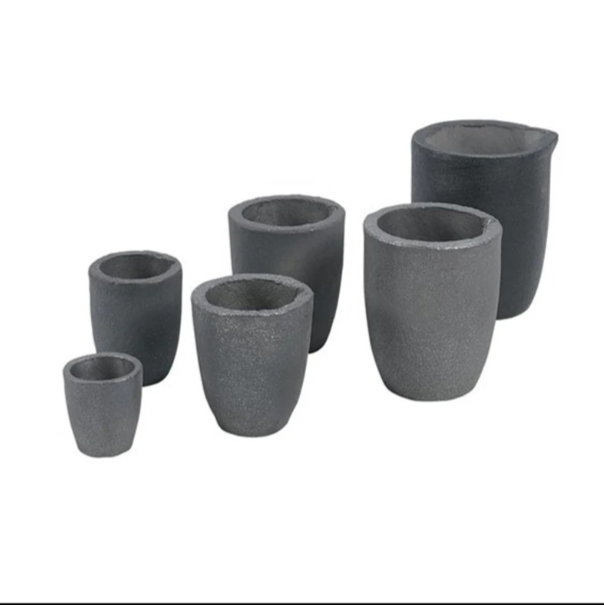
Graphite Crucibles are high-temperature receptacles that can hold liquid materials such as metals. They are widely used in metallurgy, which involves casting, the manufacture of jewelry, and heating in industry.
Graphite being a suitable material for these conditions does not mean that it is the only one, since graphite has very high thermal conductivity and thermal shock resistance. Other considerations may be the size, purity of the graphite, furnace type, atmosphere, and material to be melted.
What Is a Graphite Crucible?
A graphite crucible is a receptacle formed using graphite or graphite substances. It is used to contain materials while they are subjected to extremely high temperatures in a process of melting, heating, and pouring the material.
In contrast to regular receptacles, the crucible should be able to withstand high temperatures and changes in temperature. The crucible needs to maintain its form and must not chemically interact with the material.
Graphite is a popular choice for such work because of its heat-conducting capabilities and low coefficient of expansion.
Why Is Graphite Used for High-Temperature Applications?
There are a number of characteristics of graphite that make it an appropriate material for industrial heating applications.
Thermal conductivity is one such feature which ensures the efficient transfer of heat energy through graphite materials.
Furthermore, graphite has a relatively small coefficient of thermal expansion. This could be useful in preventing any stress on the crucible because of changes in temperature.
The third factor is thermal shock resistance, which would enable the crucible to withstand temperature changes without the formation of cracks.
But then there are certain circumstances where graphite might not be an appropriate material. Oxidation of graphite becomes a major issue when it is placed in oxygen at high temperatures.
Common Applications of Graphite Crucibles
Graphite crucibles are used across several areas of metal processing and high-temperature manufacturing.
Metal Melting
One of the most common applications is melting metals before casting. Depending on the crucible design and material compatibility, graphite crucibles can be used for various non-ferrous metals and alloys.
Foundry Operations
The crucibles are used in foundries for heating and holding of the material in the liquid state before its transfer into the molds.
Gold and Jewelry Working
For working with precious metals and making jewelry, there are small-size graphite crucibles available. They should be selected based on the metal, furnace, temperature, and capacity requirements.
Metallurgical Processing
Graphite crucibles can also be used in metallurgy laboratories and industries where heating at a certain temperature level is needed.
They have more functions other than being used to melt substances. Different types of crucibles can be required for specific uses.
Types of Graphite Crucibles
Not every graphite crucible has the same construction or performance characteristics.
Some products are manufactured from relatively high-purity graphite, while others use graphite-based composite materials. Examples found in industrial applications include clay-graphite, silicon-carbide/graphite, and isostatically pressed graphite products.
There are distinct features for each.
The selection criteria will include the type of material to be melted, the type of furnace, heating mechanism, temperature, environment, and the production process.
For that matter, it is important for buyers not to consider the price and capacity of the crucible in their selection criteria.
How to Choose the Right Graphite Crucible
Several parameters should be considered when selecting a crucible.
1. Material Being Melted
Start by identifying the metal or other material that will be processed. Chemical compatibility can vary between different materials and temperatures.
2. Crucible Capacity
Capacity should match the required batch size and furnace configuration. An oversized or undersized crucible may create unnecessary handling and heating issues.
3. Furnace Type
The heating system has a direct influence on crucible selection. Induction, resistance, gas-fired, and other furnace designs can impose different requirements.
4. Operating Atmosphere
Atmosphere becomes especially significant in the case of using graphite under conditions of elevated temperature. The presence of oxygen may cause oxidation to occur faster.
5. Graphite Quality
Graphite purity, density, structure, and manufacturing consistency can affect product performance. Industrial buyers should request relevant material and product specifications from the manufacturer.
6. Dimensions and Shape
The crucible must fit correctly inside the furnace and allow suitable heating and material handling. Custom dimensions may be necessary for specialized equipment.
Why Manufacturing Quality Matters
A crucible operates under demanding conditions. Small differences in material quality or manufacturing accuracy can affect its performance during repeated heating cycles.
Professional manufacturing involves careful control of the graphite material and the final product dimensions. Depending on the product, processes may include forming, heat treatment, graphitization, machining, and inspection.
Surface condition and dimensional accuracy can also matter when the crucible needs to fit a specific furnace or production system.
For industrial buyers, consistency is especially important. A crucible that performs predictably from one production batch to another can make process planning easier.
How to Extend Graphite Crucible Service Life
Correct handling can help reduce unnecessary damage.
Avoid sudden exposure to different temperatures when it is possible. Such an operation may cause thermal shock even for thermally shock-resistant materials.
The crucible should also be protected against any mechanical damage while filling, mounting, and dismounting. Damage becomes more serious after further heating.
All conditions of use should correspond to those recommended by the manufacturer of the crucible. Atmosphere, temperature, materials, and heating regime can affect crucible service life.
Proper storage is also useful. Crucibles should be kept dry and protected from contamination or physical damage before use.
Why Choose a Professional Graphite Crucible Manufacturer?
Industrial users often require more than a standard product. Furnace dimensions, batch sizes, material requirements, and production conditions can vary significantly between applications.
A professional manufacturer can help buyers evaluate factors such as graphite grade, dimensions, capacity, and application requirements.
Haoxing Graphite is a company that produces graphite materials suitable for industrial purposes and offers graphite crucibles to those who need high-temperature graphite material. The customer can check out the product specifications and communicate with the manufacturer about their process requirements.
Frequently Asked Questions
How can we apply the graphite crucible?
It is generally used for containing materials that undergo heating, melting, and pouring processes. It is usually used in the fields of metalworking, foundry, jewelry manufacturing, metallurgy, and others.
Why is graphite material convenient for crucibles?
The characteristics of this material include its good thermal conductivity, moderate thermal expansion, and resistance to thermal shocks; hence, it can be used at high temperatures, although it depends on certain conditions.
Is it possible to use graphite crucibles for metal melting?
Yes, it is possible. Graphite crucibles are used for metal melting processes. The choice of a proper product should take into account the material that will be melted, furnace, temperature, atmosphere, and capacity.
How to choose the right graphite crucible?
There are many factors that should be taken into account during the selection, such as the material for processing, crucible capacity and dimensions, furnace, heating, atmosphere, graphite quality, production conditions, etc.
Is it possible to customize graphite crucibles?
Many companies manufacture custom-sized crucibles according to the customer’s requirements. Such service is very helpful when there is a need to make a crucible for a special furnace or process.
Conclusion
Graphite Crucibles offer a viable solution for many of the melting and processing needs at elevated temperatures. Graphite is suitable for such applications because of its properties, including thermal conductivity, thermal expansion, and ability to withstand thermal shock.
The key lies in selecting the appropriate product that will satisfy the needs of specific applications. Compatibility of materials, capacity of the crucible, design of the furnace, atmosphere, and quality of graphite should all be taken into account before buying.
