
Training a machine learning model requires data — often large volumes of it. But in many real-world situations, collecting sufficient data is either impractical or ethically restricted. Medical records, financial transactions, and rare industrial failure events are examples where data is either limited in volume or protected by strict privacy regulations.
Generative Adversarial Networks, commonly known as GANs, offer a compelling solution to this problem. They can generate realistic synthetic data that mirrors the statistical properties of real datasets, without uncovering any actual sensitive information. For learners pursuing an artificial intelligence course or any structured AI program, understanding GANs is increasingly important as synthetic data becomes a cornerstone of modern machine learning pipelines.
What Are Generative Adversarial Networks?
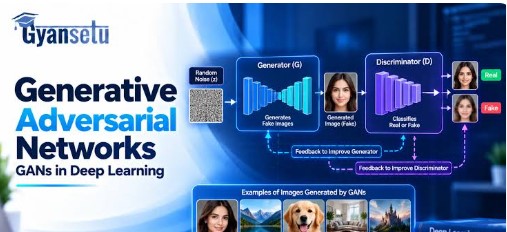
A GAN is a class of deep learning model introduced by Ian Goodfellow and colleagues in 2014. The architecture consists of two neural networks that are trained simultaneously in opposition to each other.
The first network is called the Generator. Its job is to produce synthetic data — images, text, tabular records, or other formats — that resembles real data as closely as possible.
The second network is the Discriminator. Its role is to examine data samples and determine whether each one is real (drawn from the actual dataset) or fake (produced by the Generator).
These two networks are locked in a continuous feedback loop. The Generator tries to fool the Discriminator, while the Discriminator works to correctly identify synthetic samples. Over many training iterations, this adversarial process pushes the Generator to produce increasingly realistic outputs.
The result is a model capable of generating new, plausible data points that did not exist in the original dataset — which is precisely what makes GANs valuable for addressing data scarcity and privacy concerns.
Why Synthetic Data Matters: Scarcity and Privacy
Two distinct problems motivate the use of GANs for synthetic data generation.
Data Scarcity occurs when the volume of available training examples is too small to build a reliable model. This is common in niche domains. Consider training a model to detect a rare medical condition. Real patient cases may number in the hundreds globally. A model trained on such a small dataset is likely to perform poorly or overfit. GANs can augment this limited dataset by generating thousands of additional synthetic patient records with similar characteristics, giving the model enough examples to learn meaningful patterns.
Privacy Restrictions arise in sectors like healthcare, banking, and legal services, where regulations such as HIPAA or GDPR prohibit sharing raw personal data. Even when data exists in abundance, it cannot be freely used for model training across teams or shared with third-party vendors. Synthetic data generated by GANs carries none of the identifiable information from the original records. It captures the statistical structure of the real data while being legally safe to distribute and use. This makes it an attractive alternative to data anonymization techniques, which can sometimes degrade data quality.
For professionals enrolled in an artificial intelligence course, both of these use cases illustrate why GANs have moved beyond academic research and into production environments.
Real-World Applications of GANs for Synthetic Data
The practical deployment of GANs for synthetic data generation spans several industries.
Healthcare: Hospitals and research institutions use GANs to generate synthetic patient records, medical imaging data, and clinical trial results. This allows the models to be trained on diverse data without violating patient confidentiality.
Autonomous Vehicles: Training self-driving systems requires exposure to rare and dangerous driving scenarios — accidents, extreme weather, unusual road conditions. GANs can simulate these events synthetically, reducing the need for costly and risky real-world data collection.
Financial Services: Banks use GAN-generated transaction data to train fraud detection systems. Fraudulent transactions are inherently rare in real datasets, creating class imbalance. Synthetic fraud examples help models learn to detect anomalies more accurately.
Manufacturing: Defective product samples are scarce by nature. GANs can generate synthetic images of product defects to train quality inspection systems on the factory floor.
Each of these examples reflects how GANs translate well beyond image generation — their core strength lies in learning and reproducing the underlying distribution of any dataset type.
Limitations to Keep in Mind
GANs are powerful but not without challenges. Training instability is a well-documented issue — the Generator and Discriminator can fall out of balance, leading to poor outputs. Mode collapse, where the Generator produces only a narrow range of samples, is another known problem. Evaluating the quality of synthetic data also requires careful validation to ensure it genuinely reflects the real-world distribution.
Despite these limitations, ongoing research continues to improve GAN architectures, making them more stable and reliable for applied use cases.
Conclusion
Generative Adversarial Networks provide a practical and effective path forward when real-world data is unavailable or restricted. By generating high-quality synthetic data, GANs enable AI development to continue even in the most data-constrained environments. As industries increasingly adopt this technology, familiarity with GANs is becoming a valuable competency. Whether you are a practitioner or a student exploring an artificial intelligence course, understanding how GANs work — and where they fit — prepares you to solve some of the most persistent data challenges in applied AI.
