
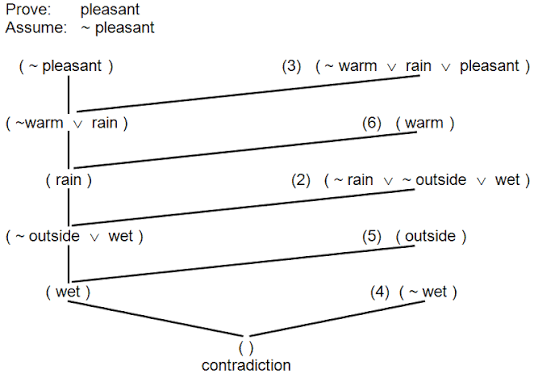
Logic forms the backbone of artificial intelligence. Before machines could learn from data, researchers had to teach them how to reason — how to derive conclusions from known facts and rules. One of the most powerful techniques to emerge from this effort is the resolution refutation method, a formal procedure for proving that a statement is true by demonstrating that its opposite leads to a logical contradiction.
This method is central to automated theorem proving, logic programming, and knowledge representation. For students enrolled in an agentic ai course in hyderabad or anywhere else studying intelligent systems, understanding resolution refutation is a foundational step toward mastering how AI agents reason over structured knowledge.
The Core Idea: Proof by Contradiction
The resolution refutation method is rooted in a classic logical strategy called proof by contradiction, or reductio ad absurdum. The reasoning works as follows:
- You want to prove that a statement P is true.
- Instead of proving P directly, you assume its negation — that P is false.
- You then apply logical rules to this assumption.
- If the assumption leads to a contradiction — a situation where both a statement and its opposite are simultaneously true — then the assumption must be wrong.
- Therefore, P must be true.
This approach is especially useful when direct proof is difficult or when working with complex sets of logical clauses. In automated reasoning systems, it allows a computer to verify logical claims without requiring human-guided proof steps.
How the Resolution Rule Works
Resolution operates on statements expressed in conjunctive normal form (CNF) — a standardized format where every expression is written as a conjunction (AND) of clauses, and each clause is a disjunction (OR) of literals. A literal is simply a variable or its negation.
The resolution rule itself is straightforward. Given two clauses:
- Clause 1: A ∨ B
- Clause 2: ¬B ∨ C
You can resolve them by canceling the complementary literals B and ¬B to produce a new clause:
- Resolvent: A ∨ C
This new clause is a logical consequence of the two original clauses. By repeatedly applying this rule across a set of clauses, you work toward deriving the empty clause — a clause with no literals, which represents a direct contradiction.
When the empty clause is derived, it confirms that the original set of clauses (including the negated goal) is unsatisfiable. This is the proof that the original goal statement must be true.
Applying Resolution Refutation: A Step-by-Step Overview
The process of applying resolution refutation follows a structured sequence:
Step 1 — Convert to CNF. Translate all known facts, rules, and the negation of the goal statement into conjunctive normal form. This may involve eliminating implications, moving negations inward using De Morgan’s laws, and distributing OR over AND.
Step 2 — Add the negated goal. Take the statement you want to prove and negate it. Add this negated statement to your existing set of clauses.
Step 3 — Apply the resolution rule repeatedly. Select pairs of clauses that contain complementary literals and resolve them. Add each resolvent back into the clause set.
Step 4 — Check for the empty clause. If you derive an empty clause at any point, the proof is complete. The contradiction confirms that the negated goal is inconsistent with the known facts, which means the original goal is true.
Step 5 — Handle failure. If no new resolvents can be generated and the empty clause has not been derived, the goal cannot be proved from the given knowledge base.
This algorithm is complete for propositional logic — meaning that if a contradiction exists, resolution will eventually find it. For first-order predicate logic, SLD resolution (used in Prolog) extends this approach by incorporating variable unification.
Any comprehensive agentic ai course in hyderabad that covers logic-based AI will walk students through these steps with concrete examples, helping them see how abstract rules translate into working reasoning systems.
Why Resolution Refutation Matters in AI
Resolution refutation is not just an academic exercise. It underpins several practical AI technologies:
- Prolog, a logic programming language vastly used in natural language processing and expert systems, is built on SLD resolution.
- Automated theorem provers such as Prover9 use resolution to verify mathematical proofs and formal specifications.
- Knowledge base reasoning in expert systems relies on resolution to answer queries by deriving conclusions from stored facts and rules.
Understanding this method gives AI practitioners insight into how rule-based reasoning systems work internally — knowledge that remains relevant even as neural approaches dominate modern AI.
Conclusion
The resolution refutation method is an elegant and rigorous approach to logical proof. By negating the goal and systematically deriving a contradiction, it transforms the problem of proving a statement into the problem of detecting inconsistency — a task well-suited to computation. For anyone pursuing an agentic ai course in hyderabad with a focus on symbolic AI, logic programming, or knowledge representation, mastering resolution refutation provides a strong conceptual foundation that complements modern machine learning skills and deepens your overall understanding of how intelligent systems reason.
