
Solar energy is not limited to big roof areas and large premises; people can use it in apartments and even in urban dwellings. The problem is to find a way to integrate the system within a small living area.
Balcony solar energy storage system integrates solar power production and battery storage in one compact system. It will assist the families to consume more of their solar energy and lessen reliance on electricity from the grid.
The system can be used by people living in apartments to utilize an unused balcony as a producer of renewable energy.
What Is a Balcony Solar Storage System?
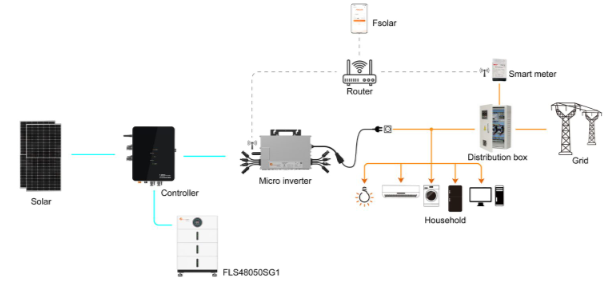
Balcony solar storage system refers to a small-sized energy source that is used by households with less space to install solar systems. Generally, balcony solar storage systems consist of solar panels, microinverters, and batteries.
The solar panels are used to produce energy during the day time while the microinverter is used to convert the energy into electricity for powering house appliances. Excess energy can be stored in the battery for future use.
The Felicitysolar balcony system consists of an 800W microinverter and a 2.56kWh lithium battery.
Why Balcony Solar Makes Sense for Urban Homes
Urban properties often have limited access to large rooftops. Apartment residents may have no private roof area at all.
A balcony can provide another option.
A compact solar power system will help in utilizing the existing outdoor space without having to set up any bulky system of power production.
This will be highly advantageous for those people who are planning to use renewable energy in their homes but do not have a rooftop system.
A small space requirement will help in installing a balcony system for such people.
How the System Works
The fundamental principle behind the technology is quite simple.
Sunlight is captured by the panels and converted into DC power. The power is then converted into AC power by the microinverter for household use.
If at any point in time the system generates excess power, then the extra power is stored in the battery. This stored power can later be used based on the system configuration.
This is how the technology helps utilize solar power based on its requirements.
Battery Storage Adds More Flexibility
Solar panels only generate electricity when there is sufficient sunlight. Household electricity use, however, continues throughout the day and evening.
This is where battery storage becomes useful.
A 2.56kWh battery, such as the one included in Felicitysolar’s balcony configuration, can store solar energy for later use. The company describes the system as suitable for supporting lighting, network equipment, mobile devices, and other essential household loads.
The actual backup duration depends on the appliances being powered and their energy consumption.
Compact Design for Limited Space
Space is one of the biggest considerations for apartment residents.
Traditional solar systems can require significant roof area and additional equipment. A balcony setup is designed around a much smaller footprint.
Felicitysolar highlights space efficiency as one of the main characteristics of its balcony ESS solution. Its system combines the microinverter and battery in a configuration intended for urban residential environments.
Before installation, users should still check balcony dimensions, structural limits, shading, mounting requirements, and local building rules.
Smart Energy Management
Producing solar power is only part of the process. Knowing when energy is being generated and consumed can also help households use it more effectively.
Smart monitoring can show energy production, battery status, and household consumption. This information can help users understand their daily energy habits.
Felicitysolar’s balcony solution includes smart management features intended to help users monitor and manage energy use.
Better visibility can also make it easier to identify periods when electricity demand is highest.
Easy Installation Can Be an Advantage
Complex installation can discourage apartment residents from considering solar energy.
Balcony systems are designed with simpler installation in mind. Felicitysolar describes its balcony kit as a plug-and-play solution intended to simplify setup.
However, “easy installation” does not mean that every balcony installation can be completed without professional assessment. Electrical connections, mounting, local regulations, and safety requirements should be checked before the system is installed.
The installation method may also vary depending on the property and local requirements.
Safety Should Still Come First
A compact solar system still handles electrical energy and should be treated accordingly.
A suitable system should include appropriate battery and electrical protection. Installation equipment should also be selected for the environment in which it will operate.
Felicitysolar lists safety features as part of its balcony ESS design. Lithium-ion battery technology is also used to store the energy.
Users are recommended to read the instruction manual and comply with their local electrical rules. Approval from building management could also be necessary in case of an apartment complex.
Does the Balcony System Cut Electricity Bills?
Yes, it does help in reducing the consumption of grid electricity, depending on several factors.
Generation using solar energy depends on many conditions like sunlight, angle, shading, weather, and availability of balcony space.
Using stored solar energy during periods when grid electricity would otherwise be consumed can improve self-consumption. The financial benefit depends on local electricity rates and the amount of solar energy the system can generate.
For this reason, expected savings should be based on the property’s actual energy use rather than a fixed estimate.
Where Can It Be Used?
A balcony solar storage system is mainly suited to compact residential environments.
Apartment residents can use it where rooftop solar is difficult to arrange. Small houses with limited outdoor space may also consider this type of setup.
Felicitysolar also identifies villas, small offices, shops, and some small-scale industrial applications as potential use cases for its balcony storage systems.
The appropriate system size will depend on the energy demand of the specific property.
What Should You Check Before Buying?
The selection of a balcony solar system should take into account more than just its battery capacity.
The size of the installation area and the amount of sunlight falling on the panel should be considered. The output rating of the micro-inverter and the battery capacity should be taken into consideration. The connection between the system and household appliances needs to be known.
In addition, there are certain rules and regulations that need to be considered.
Lastly, it should be determined whether expansion is possible or not.
A modular setup may be useful if household energy needs increase later.
Final Thoughts
It would be beneficial to install a balcony solar energy storage system in order to conduct a research on renewable energy in an area where there is lack of space.
Such installation allows combining the usage of solar panels, micro-inverter and the battery storage, which will enable an urban family to produce more electricity.
Space saving design of the system would be especially useful for apartments.
The balcony ESS system offered by Felicitysolar includes 800W micro-inverter, 2.56 kWh lithium battery and other additional options such as smart management system, scalable design, space-saving, etc.
In any case, there is no guarantee of success since all factors such as availability of space, sunlight, energy consumption, laws and electrical configuration should be taken into account.
