
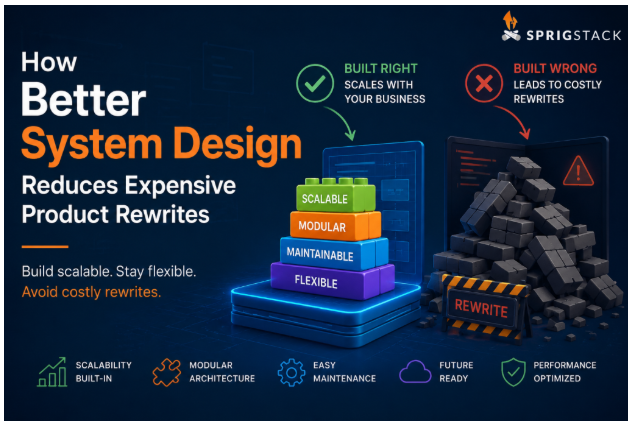
magine a team that has spent more than eighteen months building an excellent product. Users came in faster than expected, and within two years, the engineering team needed a full rebuild. The original codebase could not handle the load, the components were too tightly woven to change independently and adding any new feature meant touching code that could make things worse.
This is not an unusual story. Many startups and mid-size companies often face the same issues with these rewrites. They even consume months of engineering time, introduce new bugs, and quietly damage customer trust.
This article explains why rewrites happen and how better system design in case of web development can help achieve the best outcome. These keep companies from rebuilding what they already built.
Why Product Rewrites Become Necessary
In case of web development, rewrites happen because the original product failed to meet the business goal. But due to a lack of efficacy, the product faces some serious constraints when the business grows.
Many of these scalability challenges can be avoided by following proven software product development principles from the start. Systems are built to serve a thousand users and often collapse when that number hits a hundred thousand users. It happens because the original database structure, API design, or server configuration was never meant to bring the best outcome for businesses.
When one part of a system is dependent on another, a change in one area causes unexpected failures elsewhere. Teams even spend more time managing that fragility than on considering core business parts.
This is why a lack of modular architectural compounds brings serious problems. Monolithic codebases that were not designed for handling separate tasks make it impossible to update one feature without risking the stability of the entire product.
What Better System Design Actually Means
Better system design in case of web development is not about using the trendiest framework or the newest runtime; it is about developing the system with a clear concept in mind so that the product can be scaled without needing to be rebuilt.
In practical terms, this means separating frontend and backend concerns clearly, so that the client layer and the server layer can evolve independently. Better system design also means designing APIs that can handle multiple tasks of modern distributed system design.
Similarly, from choosing the best database structures that support the queries from the application that can be easily scaled, a better design structure ensures everything.
Better design means writing code that the next engineer on the team can easily read, understand, and extend without needing a guided tour. Web applications that are built this way can handle operations more gracefully.
What Are the Key Ways Strong System Design Prevents Rewrites
When it comes to preventing the chances of rewrites, there are key ways to help you make the best decisions.
- Scalability is Built from the Beginning
When a web application is strongly architected for growth, handling more users, more data, and more geographic regions, businesses get the chance to take part in a planned operation rather than an emergency.
Backend services, indexed databases, latest content delivery networks, and horizontal scaling strategies all contribute to an advanced system that can expand without a structural rebuild.
- Modular Architectures Simplify Updates
A well-structured web application gets distinct layers and services. The frontend communicates with the backend through defined API contracts. Business logic gets the server layer separated, not scattered across UI components.
This kind of isolation reduces risk during upgrades, speeds up some feature releases, and gives teams the overall confidence to iterate without fear of breaking things that should not be connected in the first place.
- Better Maintainability Reduces Technical Debt
Clean and well-organized web codebases are much easier to debug and test, and it often gets extended with time. When new developers join a team, a system with clear structure and consistent patterns lets them contribute easily within days rather than weeks.
From readable frontend components to documented backend endpoints and predictable data flows, all things lower the long-term cost of keeping a product running. Over time, systems built with maintainability in mind face fewer disruptive interventions and could stay stable.
- Flexible Integrations Support Future Expansion
Modern web development depends on certain external services. From payment gateways, authentication providers, to multiple data analytics platforms, communication APIs, and more, there are multiple things a website handles. Hence, systems built around well-defined REST or GraphQL APIs can easily be integrated with existing systems without requiring changes to the core web application.
For example, when the business swaps a payment provider or even adds a new data source, it becomes a serious engineering task rather than just handling a project that touches every layer of the product.
- Performance Optimization Happens Earlier
Slow web applications lose users. Performance problems that already exist in a system’s structure, for example, synchronous blocking operations, unindexed database queries, or oversized frontend bundles, these things cannot be fixed with surface-level patches.
When database design, server-side caching, lazy loading, and efficient API responses are considered during the design phase, the application can bring the best results. This prevents the chances of performance-driven rebuilds that teams often face after a product has already started gaining real traction.
Below are certain consequences of poor system design -
- Delayed launches resulting in features stalling for months
- Lost revenue resulting in slow pages and downtime costs sales
- Engineering drains results in teams needing to rebuild instead of innovating.
- Customer churn instability erodes trust fast.
- Infrastructure costs resulting in inefficient systems overspend
- Opportunity cost resulting in competitors’ move while you rebuild
What Are the Best Practices for Designing Products That Last
As web development services advance, most developers are asked to design products that last. Below are certain aspects that you can consider to bring the best outcome.
- Plan for Scale Early
Design your database schema, API structure, and service boundaries with the current load in mind. The upfront cost of doing this is lower than retrofitting under pressure.
- Separate Frontend and Backend Concerns Cleanly
Keep business logic out of UI components, and you can successfully define stable API contracts between layers. This lets each side properly evolve with time.
- Document Systems Thoroughly
Undocumented APIs and unexplained architecture decisions become liabilities when team members leave. Good documentation is part of the product.
- Invest in Code Reviews
Regular reviews catch certain structural problems before they harden into technical debt that takes months to unwind.
- Use Cloud-native Infrastructure Where Relevant
Managed services, containerized deployments, and CDN-backed frontends reduce certain operational overhead and make scaling a configuration task rather than an engineering project.
- Conduct Architecture Reviews Regularly
As a web product grows, early design decisions need to be properly revisited. Scheduled reviews allow teams to catch certain emerging constraints before they force a crisis response.
Conclusion
Strong system design is not just a technical luxury; rather, it has become a necessity to avoid hassles later. It is also strongly considered an excellent foundational business decision that determines how fast a web product can grow, how much it costs to maintain, and how reliably it serves its users.
Companies that treat excellent web development architecture as a genuine investment from the start can save thousands of dollars spent on thoughtful system design. These not only convey the new features but also provide better user experiences that bring the best assistance.
